Tuesday, August 23, 2005

Marketing - Position before you communicate

Many marketing programs in large and small firms flounder, marketing plans change directions, go around in circles and often the message is lost before it reaches the customer. This is analogous to the situation in "Alice in Wonderland", where Alice asks the Cheshire Cat which path to take? Cat asks "Where do you want to go?" Alice says "Anywhere, As long as I go somewhere.". Cheshire Cat responds "If you don't care where you're going, it doesn't make a difference which path you take."

The situation is similar to the marketing programs in many firms. Without direction or focus, an organization often goes around in circles - always working hard but going nowhere.

Importance of Positioning

From a management perspective, positioning is the center of an effective marketing plan. A well-crafted positioning statement defines your company's direction. A well defined positioning statement answers seven essential questions:

  1. Who are we?
  2. What business we are in?
  3. Whom do we serve?
  4. What is needed by the market we serve?
  5. Who are the competition? - (In specific who is the number-1 competition)
  6. What is unique in our business model?
  7. What are the unique benefits our customers derive from our products & services?

It is not surprising if one finds members of top management are not in total agreement to the answers to these questions. And that is the first signal of a bad market positioning.

Positioning Defined

A market position (or statement of position) is a cold-hearted, no-nonsense statement of how a company is perceived in the minds of your customers, prospective customers, stakeholders and employees.

Companies cannot declare a marketing position - it must be earned in the minds of the customers, potential customers and stakeholders. Marketing is a means to acheive that market position. When I say marketing, I mean a mix of marketing tools may have to be used to achieve the desired market position.

Getting that market position

The process for developing your company's positioning statement and path is discussed below. The purpose of a market position is to create a clear, consistent and a continious way the organization speaks to its market. This makes all forms of marketing communications less complex and easier to manage. But getting there takes patience, discipline, negotiation and above all an "outside-in" perspective, i.e., take an outsider view of the firm. Hiring an external agency or public relations agency can be of useful in creating a market position.

Step-1: The Right Information

To begin with, one must have the right information i.e., answers to the seven questions that a positioning statement must answer. For one reason or other many companies don't share business or marketing plans with all employees, external PR agency, and/or advertising agency. If the firm does not have the answers to the above questions, then there is lots more work in store.

Step-2: Use the Right People

Get the top managment buy in on the market position. The CEO, CFO, VP's and directors must be in agreement to the market position. Next, Enlist all those employees who are in contact with customers (direct or indirect). It is essential for all employees who interact with customers to be in agreement with the market position the firm wants to take.

Step-3: Train you folks

Work with and train all the employees and top managment to think and act in accordance with the market position. Outline the expected outcome and the benefits that communications consensus will bring and circulate in an e-mail or memo to all those involved. The most understandable benefit is that time and money will be saved in developing communications tactics. The most strategically valuable benefit is more effective communications resulting from consistent, cohesive and differentiated messages building market awareness, thus helping achieve the company's desired position.

Step-4: Generate Ideas

Concentrate on uncovering issues, competitive and internal differences of opinion. Get people talking and discussing the seven key positioning questions in turn. Customer or prospect survey questionnaires can provide the outside-in perspective and realistic answers about the company's present position. Also be sure to examine and be aware of what key competitors are claiming about themselves.

One of the most important aspects of the positioning statement exercise is that all affected managers see and hear each other's ideas. It is only though this face-to-face process that understanding and consensus occurs. Try ensuring that every manager's ideas and thoughts are noted.

Step-5: Challenge their thinking

Remind your people that the goal is uncovering direction by defining what is real as well as firm's ideal vision. This includes company and competitors' strengths, weaknesses, competitive threats, opportunities (SWOT analysis). What is being sought are reasonable and compelling supports (key messages) for a position verses competitors (But do not a position in a vacuum).

The hardest thing for many people to grasp is the concept of narrowing rather than broadening a company's focus. Differentiation is essential. If your people can't determine differences in the company, they need to look harder. Differentiating on price is usually a dead-end.

The desired result is a positioning statement and supporting messages that reflect today's reality and help move the company toward it's sought after, achievable, differentiated position. Remember, claiming to be "the leader" does not make it so.

Step-6: Playing it back

Once the first round of matket positioning is over, provide a summary and positioning statement as pervieved by an external agency. Craft your positioning statements and a set of key supporting statements for consideration during the next round.

The second round of market positioning should focus on refinement and agreement on one positioning statement and a limited set of key messages. If management output has been unfiltered, then the proposed statements and messages should be close to the final statement.

It is essential that during the entire exercise, a mission leader (external agency or marketing manager) should drive the process towards consensus and closure. Make careful note of agreements and modifications to the proposed statements and messages.

Publish the final position statement soon after the exercise ends to prevent an endless loop of iterations, changes, additions and more meetings.

Clear path Ahead

Finally, the firm begins actively applying its new positioning statement to all communications (internal and external) - from marketing collateral to sales material, Web sites to press releases. This means that if communications do not support the sought-after positioning or do not include, reflect, address or amplify the positioning statement and key messages, they are off strategy and are not acceptable.

Step-7: Get The Word Out

This is what's needed to initiate an effective position-driven communications program. Advertising or direct marketing must now follow the positioning statement. Their involvement ensures that they will support and implement the positioning statement and key messages.
Now it's up to the marketing communications, public relations and advertising managers to guide and control the consistent use of the statement and key messages by all those who are communicating. That takes some more work. But the payoff is communications success.

Wednesday, August 10, 2005

Web Marketing with Google

Having greatly benefited from my relationship with Google in the past several years, I am dedicating this blog to the search engine superstar.

I got to know Google several years back, when it was just a small fish in a big pond. I started to analyze its every move and realized that Google is a fickle, clever and extremely mysterious being. Still, I decided to get more acquainted.

Here are a few things I learned along the way.

Google works on Logic

In other words, avoid participating in anything that may blacklist you from this search engine, including keyword stuffing, link farms and hosting 50 "sister" sites on the same server. Keyword stuffing doesn't refer merely to the content of your site, but also the alt tags, headers, URLs and any additional areas of your web site. Google bots give a lower priority to sites which have excessive key words or have link farms or if there are multiple sites on the same server.

Google likes to stay focused

When optimizing the individual pages of your Web site, try to hone in on one or two relevant keywords per Web page. Analyze each page and identify which keyword would be most suitable.
If you decide to optimize for two keywords per page, make sure that they are similar in context. For example, if you are optimizing for the key phrase "insurance leads," you may also consider optimizing for "insurance sales leads" within the same page.

Google is popular and expects the same from you

The more popular your site is across the Web, the more Google will favor you. Obviously, having several high-quality inbound links to your site is key in achieving higher rankings. When identifying Web sites for inbound links, target the ones that are highly relevant to your site. For example, if you run a jewelry site, look for sites that are purely informational on the topic of jewelry or gemstones. Also, make sure that the sites you decide to partner with have a good PageRank (at least a 5) and online presence.

To save yourself a lot of hassle, conduct a keyword search relevant to your business and target the Web sites that show up on the first and second pages of Google (weeding out the competition, of course); contact the Web masters of those sites and tell them about your company and find useful ways to compensate them for adding your company's information on their site.

If you have an affiliate program, don't be shy to pitch it. If you have an online advertising budget, offer them a pay-per-click deal or monthly advertising fee for promoting your Web site. Note that partnering with these sites or purchasing ads should complement your overall marketing and business development strategy—and not be used merely to get link value.

Google gets bored easily

Regardless of whether your site is informational, e-commerce or just a sophisticated version of a business card, having quality content is crucial. Adding to that factor is how often you update your site's content.

If you run a site that has new content added on a daily basis, then eventually the Google "freshbot" will start visiting your site on a daily basis and indexing your new content into the database. The more content you update, the more Google visits your site and indexes it quicker.

Google loves to travel

It is commonly known that Google loves links, both inbound and outbound. Lots of research has focused on inbound links, but little has focused on the number of links on an actual page. It appears that Google favors sites that have several internal and outbound links over those that don't have links.

If you have any doubts about this theory, simply do a search on any high-volume keyword or phrase within this search engine and analyze the first few sites that come up. Notice how the majority of them have numerous internal links on the main pages of their Web site.

Closing thoughts

Keeping pace with Google is not an easy undertaking. It takes a certain level of knowledge, skill and creativity to truly benefit from this relationship. The rest is up to the stars.

Thursday, August 04, 2005

Retaining People in Technical Jobs

Introduction

Since I work as a engineer in a high tech company, I have learnt a few things of technical recruitment. Having worked in the USA & India and seen a boom to burst to boom cycles, it is interesting to know that that average tech worker remains in a company for about 18 months - this is same in most countries. This raises two interesting questions:
  • Why do tech workers get antsy after a year and a half?
  • Why is it that tech workers remain an average of 18 months in a position.

Given the cost of employee turnover, it is important to know the reasons why employees leave.

Cost of Turnover

Various formulas place the turnover cost of an IT worker from anywhere from 1.5 to 3 times the persons salary. A $50,000 programmer could cost from $75,000 to $150,000 to replace. Why so high? A myriad of direct and indirect costs associated with finding, recruiting, screening, interviewing, hiring, training, and integrating a new employee. Another major hidden cost is lost business or projects left idle.

Why tech workers get antsy after a year and a half?

The reason they get antsy is partly in the nature of technical work itself. Many engineers feel they have finished their work when their project is functioning smoothly. If they cannot find another interesting position internally, or if they want to continue developing software or projects, they have no choice but to look elsewhere.

Recent studies of high-tech employees suggests that three main factors affect IT employee retention:

  • Work environment (e.g. challenging work, atmosphere, physical environment)
  • Educational opportunities
  • Quality of life

Compensation and benefits were mentioned but to a lesser extent. Most of them are aware of the demand for their services and know that all they need to do to get a salary increase of 12-15% is to put themselves on the job market again.

The need for challenging work is often a factor in the allure of the dot.com's. Not surprisingly, many companies find it difficult to provide a constant challenge for their high-tech workers. Sometimes the work is of a maintenance nature and not quite as stimulating. Notwithstanding the inability to provide a continuos challenge, companies strive to make the rest of the work environment pleasant in the hope of keeping their staff.

Business Life Cycle

An interesting aspect of the technical recruiting is its involvement with two evolutionary milestones in a high-tech business - its birth and death. When a high-tech startup (including the dot.com's) develops its business plan, one of the critical needs is the right technical staff. In a tight labor market this must occur early in the process and a recruiting firm is often employed.

Conversely, when a high-tech business is in financial trouble, the employees that catch wind before the ax falls quickly distribute their resumes through technical employment venues. So from this unique vantage point we learn which businesses are posturing for start and those that are closing their doors. Between those extremes, however, we hear the grumbling of the high-tech employee that are invisible to the employer they are about to leave. In the interest of finding another job they share information with recruiters that they don't share with their family or friends and certainly not with their former employer. And the most pressing question that employers have for them is why are you leaving?

Knowing the cost of hiring, several research studies have been done on employee retention. The results of these studies can be summarized as simple but effective formula for employee retention to be strictly followed:

  • They are selective about whom they hire. At least four people interview each candidate.
  • Hire only what they need. Avoid hiring for project only and then have to terminate later.
    Make them feel wanted and important to the company. They mentor new hires and emphasize a strong personal touch.
  • Office environment, build around the employee versus making them fit a mold. A personal space that is tailored to the individual makes the workspace pleasant

Some companies allow additional flexibility by letting their employees telecommute on a limited basis. Workforce automation tools such as Web-based Knowledge Management Tool allow companies to link their geographically dispersed workforce through a common interface.

Educational opportunities are very important to IT workers. A survey by the web portal ComputerJobs.com revealed the 93% of IT workers surveyed (2296) said educational opportunities were "critical" to their career. Getting the education to keep one's skills current in their work requires the type of flexibility to balance work and education. Learning should be an ongoing part of a company's corporate culture - but again flexibility is important to meet individual learning styles. Some people want formal classroom training while others learn best through books and on-the-job training. Budget training dollars for each employee - some are using this money to pay for degree classes at universities while others stock up on technology books from the bookstore."

Quality-of-life reasons for an employee leaving apply mostly to those relocating to another living environment and not to those making job changes within this region. We discovered many sought this area as an escape from the metropolitan maze of traffic, crime, congestion, smog etc. That area's waters and beaches are a strong attraction for those fed up with the rat race. This lifestyle attraction is key to the strategic vision of attracting IT workers. But it is important to note that those content with the quality of life are less likely to leave the region. However, high-tech employees motivated by primarily by compensation will follow the money wherever it takes them.

In an information technology economy shaped by knowledge-based workers, the financial cost of a technical member leaving is akin to robbery, embezzlement, or litigation. It is as financially horrific as the corporate knowledge that a high-tech employee takes when he unceremoniously walks out the door. And this is not a commercial problem alone. Projects stymied or aborted by lack of technical expertise are equally devastating.

Conclusion

Many companies today are aggressively pursuing measures to redefine the workplace in order to minimize turnover costs and intervene early into situations in which a critical member may be taking flight. In some larger firms an "Office of Retention" has been created to be a focal point for retention matters. This office can easily pay for itself by keeping a key employee. Making the workplace challenging and pleasant has now become bottom-line driven as retention will play key role in the success of the company.

Monday, July 25, 2005

Giving Customer Quotations over Internet

Introduction

In complex business purchases, a price quote contains more than the basic price. It contains the delivery schedule, engineering details, manufacturing process details, legal terms & conditions, quality assurance details, contingency plans, risk mitigation plans etc. The quote has to answer all the questions asked by the customer and also answer all the potential or possible questions that will be asked by the customer.

The readers of the quote will be many and from different backgrounds. The VP or director of Engineering will be interested in the engineering details and schedule. The program manager will be interested in the overall price, schedule the engineering details, CFO will be interested in the pricing details, pricing terms & conditions, Company legal department will be interested in the legal terms & conditions, contingency clauses etc. Thus a quote will be read by many members of the customer organization and each member may give greater importance to a particular section of the quote.

Delivering a Quote
Usually, the customer firm will allocate a single individual to issue the Request For Quotation (RFQ) and that person will be receiving the quote. The common practice of delivering a quote is very formal. The quotation is printed on the company letter head, signed by a senior manager and hand delivered to the customer or customer representative by the concerned salesman.
The main advantage of hand delivering the quote is that one can learn the customer’s response through their body language and through the small chat at the point of delivering the quote.

Human interaction during handing over the quote also builds an interpersonal relationship which will be of immense value in the future. However, this formal delivery of quote has certain disadvantages: Firstly, the customer has to make copies of the quote for other members of his organization to read, a soft copy of the quote has to be emailed to and often printed by all the concerned parties. Secondly, and most importantly, the firm which delivered the quote may fail to learn about the customer’s preference. Salesman may fail to transfer his experience, insights and knowledge gained from that interaction to his colleagues and others in the firm. The firm has no knowledge of any progress or developments once the quote is delivered.

To overcome some of the disadvantages, one can turn to Internet. Delivering a quote over the Internet along with a printed copy will give great advantage to the firm. The possible uses & advantages of delivering a quote on Internet will be described in detail later in this blog.


Benefit from Internet Quote Delivery

Internet is a great tool. The usefulness of Internet need not be reiterated, but the usefulness depends a great deal on how it is used. Giving a soft copy over Internet will have the following benefits to the customer:

  • Customer now has the freedom to read the quote at his leisure
  • Easy distribution of quote - many people can read the quote at once.

The real big advantage will to the firm delivering the quote. Some of the common advantages are:

  1. By having a user ID & password to access the quote online, the company can track who is reading the quote, how many times it was read & when it was read or accessed.

  2. By splitting the quote into multiple pages, the company can track who is reading which section of the quote. Depending on the time spent on that particular page, one can estimate the level of customer interest in that section of the quote.

  3. By having the sales person create a customer access area to the quote and making the sales person enter his experince/opinion of the interaction while delivering the quote - the company can capture that information for use by rest of the company.

  4. Collecting statistics of the online quote usage, a statistical model of customer behavior can be built once a sufficient number of samples are collected.

    Statistics should be collected regarding the frequency of web visits, frequency of any data collection or capture, and the dates of access.

    Tracking the dates will help us build statistical models in future as to how much time it takes from submitting to access to purchase order

Architecture for Online Quote delivery system

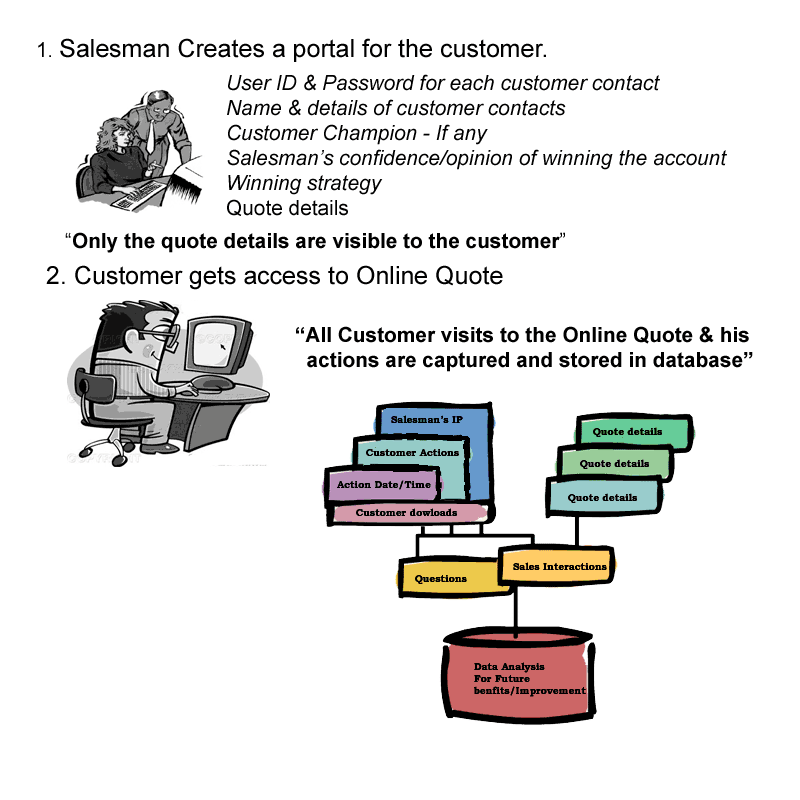
The customer portal must be created by the concerned sales person - A standard template & processes can exist, but the salesman creates a customized customer portal which contains the quote details. Salesman creates a user ID & Password for the customer and gives that to customer. He also has to input the contact person in customer company, a customer champion (if any), winning strategy for that account, customer’s pain point as perceived by him/firm, his opinion/confidence on winning the account, and his experience when meeting the customer.

The quote as such will be displayed in a series of web pages. The quote should not be available as a single downloadable document online. Each web page of the online quote will be copy protected, and user can download that single page. This will enable the firm to tack who is reading which page, how much time is spent on each page and how many times its downloaded.

A separate section for customer’s question in each page or a comprehensive customer feedback/question page must be provided to enable customer to clarify his/her doubts. The question page can be linked to cell phone or pager of the sales person responsible for that account and it will alert the salesman when ever the customer sends a question.
All the customer to firm interactions over this web page and all the statistical data collected from that web page will be collected and stored in a database for future analysis.

Web based quote system will have the following section:

Admin Section: For Sales person to create a quote portal for the customer

User Section: For customer to log-in and see the quote. Customer needs to login with a password to see the quote.

Super Admin section: To create the quote template, data capture features and database integration.

Analyst Section: For Sales/Marketing department to collect & analyse data.

The quote will be presented in multiple web pages, each page dedicated for a particular information:

  • Project details
  • Manufacturing/Engineering details
  • Schedule/Effort required
  • Pricing
  • Payment terms & conditions
  • Legal disclaimers, terms & conditions Etc..

Each page will be copy protected. But an option can be given for customer to download that section of the quote in PDF form. This will allow the firm to track the web page visits & downloads.

Each web page will have a question section, where a customer can enter any doubts or questions regarding the quote. This page is linked to email &/or cellphone of the sales person - who is alerted of the customer’s question as it arrives. An query escalation system can be built if necessary.

Data Analysis

Basic use of data capture will help the firm to know if the quote is being accessed & how often. Over a period of time, a whole range of data can be collected for analysis and the system, quote, quote delivery can be further improved based on the analysis.

Data in the quote and customer segmental information can also be captured by this system. This will help the firm to detailed analysis regarding their market segment, process details, schedule improvements, pricing information etc. This will be of immense value for management & Board to improve the business process.

Thursday, July 21, 2005

Self Service Technologies - Enable customers to provide their own service

One of the major recent changes in consumer behavior is the growing tendency to interact with technology to create services instead of interacting with a live service personnel. Self Service Technologies (SST) is a set of customer interface technology that allows customers to produce their own service instead of interacting with a service providing employee. A classic example is an Automated Teller Machine (ATM). ATM allows bank customers to serve themselves with most of the commonly needed banking service.

Today, the list of services customers provide themselves are huge: Airline booking, Banking, self service gas stations, travel planning, package tracking, tax filing etc. These services can be classified in three categories:
  1. Customer Transactions
  2. Customer Service
  3. Customer Self-Help

The reason for such massive proliferation of customer self-service can be attributed to:

  • Customers are technology savvy: Customers understand how to use the technology & know how they can serve themself better.
  • SST works: When SST works as they are supposed to, customers are delighted.
  • SSTs are better than the human alternative: SSTs can save time, costs and offer more flexibility than the human counterpart. Internet & telephone based SSTs allows customers to choose the time when they need the service. The quality of serivice through SST is always at an assured standard - unlike a human interface, where quality of service varies with the person who is providing the service.
  • SSTs help customers in difficult situation: At times of crisis or difficult situations, customers want reliable service fast. SSTs emables the customer to provide the much needed service themselves.

The practice of self servicing has grown from consumer domain to Industrial business domain. This is natural, People who are used to self service in their personal life also want the same in they work life. Corporate banking such as Demand Orders, LoC etc can be done online.

A classic example of SST in Business domain is Cisco’s customer service. Cisco provides routers and networking devices which are critical to keep businesses running soomthly. If these devices fail, customers want that problem to be solved immediately.

To address this, Cisco turned to Internet. It built a world class model of customer service using the internet. The Internet based customer service system has set Cisco apart in its industry and helped to build customer loyalty in a highly competitive environment.

Essentially, Cisco put customers in charge of their own service through Internet. In most cases, customers can solve their serice problems with no intervention of Cisco personnel. Access to the solution is immediate, and solutions are customized for the individual customer. Called as "Cisco Connection Online" - It has helped Cisco improve its customer relations, reduce service errors, and win customer loyality.

Currently, more than 80% of customer problems care handled via "Cisco Connection Online" . Customer satisfaction has improved tremendously and has become a differentiating factor for Cisco. This is truly a win-win situation for Cisco and its customers.

A note of caution

SSTs can destory customer relationship and hence customer value if there are problems. Companies that deploy SSTs must be aware of the fact that their technology can be prone to failures, glitches or misuse.

Customers hate the service providing firm when they face problems with SSTs. Common problems with SSTs are:

  • SSTs fail: Technology is always prone to failure. An ATM may not work due to power failure, Internet connection failure, Machine malfunction etc. When this happens, customers do not blame the ATM but they blame the bank!
  • Customer Interface is poorly designed: Poorly designed technologies that are difficult to use or understand annoys customers. A poorly designed webpage will make turnoff the customer from buying and will avoid using that website in future.
  • Customer messes up: Not all customers will be technology savvy. Some customers need more hand holding, more training to use the SSTs. When customer messes up, they usually blame the technology, the company which used the SST.
  • There is no service recovery: When technology or process fails, customer is left high & dry. SSTs cannot provide ways to recover on the spot. Customers are forced to call or visit the company, and that was what they wanted to avoid by using SSTs. For example, if the ATM fails and gobbles up the ATM card, customer must call the bank to get his card back.

Conclusion

It is evident that as technology innovation increases & societies become more technology savvy, customers will like to serve themselves if SSTs are useful to them. To make SSTs useful and successful, it must be fail proof, easy to use and have recovery system in place when they fail.
An example of service recovery in ATM can be: When ATM fails, it should shut down the user interface screen or display a clear error message, alert the bank of the failure & the bank must respond quickly to rectify it.