Thursday, September 14, 2006

Partnerships for Increasing Business Opportunities

Today in IT services world there is a web of partnerships between various product vendors, value added resellers, IT consulting companies and IT services providers. To illustrate, Wipro has partnership with SAP, Oracle, HP, IBM, Seebeyond, Cramer, Infovista, Metasolv, Oblicore, Openet, Subex & several others. eSilicon has alliances with Cadence, TSMC, Agilent, TSMC, ASE, Amkor etc.

Companies enter into multiple alliances because it is one of the cheapest, fastest and easiest ways to grow your business and test new market opportunities. For example, Wipro can now sell IT services to an European Telecom operator because the telecom operator is using Subex software - and wipro know how to integrate Subex's billing software with SAP & Oracle. Product vendors on the other hand win by getting IT service providers to do marketing for them. Since Wipro supports Subex, Wipro will recommend for additional software licenses of Subex to the telecom operator if necessary. This prevents a competing product from Convergys being sold.

Another good example is the relationship between Cell phone operators and cell phone manufacturers: See how Nokia markets its handsets through Cingular. http://news.yahoo.com/s/ap/20060912/ap_on_hi_te/cingular_nokia_smartphone_1

Today the joint marketing efforts are seen everywhere. However, managing marketing partnerships is not easy. There are several challenges to make it successful. To build a successful marketing relationships, I follow the following rules:

  • Define what you want
  • Define who you want as a partner
  • Develop a fair business sharing model
  • Be creative
  • Keep it simple

Rule 1: Define what you want

If you want access to a particular market, partner with a company who will help you to sell into that market. For example, Wipro can partner with Convergys - wherein Convergys will train Wipro engineers on it's "Geneva" software and together Wipro & Convergys can pitch for Telecom billing solution at British Telecom. Similarly, eSilicon can have an alliance with ARM and jointly market their silicon solution for HP.

Before you begin talking to partners, know why you are seeking partnerships, and how you will measure success. Start with a small test first, to see if the results meet both parties' expectations, then roll out the partnership in a larger way. The small test should be a business opportunity - wherein you can test: Working relations, sharing the gains, work cultures etc.

Ask yourself:

  • What are you testing?
  • How big is the opportunity?
  • What economic terms will work?
  • What are your showstoppers? Areas where you can't be flexible?
  • What metrics will you be using to evaluate success?

You also might ask, "How will we know if this partnership is successful?" You can't expect the other side to know what is important to you - make sure that you know!

Rule 2: Know who you want to partner with

Once you have decided on what you want, the next question is to decide on who you should partner with? Today most IT services companies get dozens of calls each day from suitors wanting to "partner." These callers might include the following:

Technology partners: They have a product that can make the company more efficient.
Resellers and agencies: They will work on commission to sell the company's product.
Providers of complementary products and services: They want to bundle their products/services with yours

It is up to you to know what it is you want. Look at your corporate objectives and the metrics you are using to assess success, and talk only with potential partners who can help you achieve your goals.

I'm currently developing vendor partnerships with a leading Silicon Valley company. My objective is to offer value added services on top of my partner's products to a telecom service provider. My objective is clear - to provide IT services. My partner's objective is also clear - to sell more software licenses & have a secured future revenue through annual license fees. My customer's objective is to ensure that they get the best quality of service and network reliability for their money.

This situation has a potential to create problems between partners. My company which is providing the IT services has to ensure that the customer is getting the value for money - so in order to do that, we recommend a certain number of software licenses from my partner - say 8 copies of that network management software is needed. But my partner thinks that the customer will need 10 copies. Extra copies means more money for the software vendor - and that comes out of the existing budget - which in turn means less revenue for my company. This problem may get out of hand - and result in an acrimonious dispute between partners.

To overcome this problem, my recommendation is: Don't partners with those who are driven to sign a deal that they don't think through the issues; but do partner with the one who is motivated to work together.

Also, when thinking about who to work with; make sure you like them. If you find them difficult, unreliable or rude during the courtship phase, you probably don't want to work with them! After all, companies are just groups of people, so it's important that the relationships be strong.

Conversely, keep a list of people you've turned down, especially those you liked; after all, objectives can change, and people can switch companies. Maybe, down the road, that person could be a great partner. Keep track of people you like and trust.

Rule 3: Be fair

Being a "tough negotiator" works great in bazaars or used car lots. But not when you are going to be working with the other party long after the ink is dry. I like to start my negotiations with a good, fair offer for a few reasons.

First, it saves time. If it's good for you, and fair to them, there's a good chance they will accept the deal and you will have a fast close and be able to quickly start growing your business together.

Second, let's say you are able to "trick" the other side into a lopsided deal. Once they figure out that they aren't getting a fair shake, they will feel resentful of you (never good to have an angry partner) or will be no longer your partner in the next engagement try to maximize the value of working together.

Don't get me wrong, there is a big intersection between "fair for me" and "fair for you," and
within that range I'd like to maximize my side. But even if I can get a partner to sign a deal that I know is not going to make economic sense for the other side, I don't do it.

The most lucrative partnerships are always the ones that are profitable on both sides.

Rule 4: Be creative

Negotiation is not a zero-sum game. If you want new customers, and they want a great brand image, they may let you market to their customer base as a way of creating excitement through your brand. There are dozens of ways to measure success, and you and your partner may have complementary objectives.

Here are some very public examples of symbiotic marketing partnerships:

  • Lay's BBQ Chips made with Masterpiece BBQ Sauce (Lay's added to its reputation for quality, Masterpiece got some branding and a big customer)
  • Toys "R" Us using Amazon as its online channel. Amazon moved beyond books, and Toys'R'Us got traffic and someone to manage its online operations.
  • Bayside Design partners with Open-Silicon Inc. Open-Silicon has a wider reach of customers and Bayside design has a niche package design technology - Open-Silicon can win high end semiconductor designs with Bayside's package technology. Bayside in turn allows Open-Silicon to market its customers.
  • EDA tool vendor Synopsys has a tie-up with manufacturing fabs - TSMC, UMC etc. so that TSMC's customers will use Synopsys's tools for timing closure.

Spend at least a few minutes with prospective partners to build rapport, understand their objectives and explain yours. The broader the understanding, the more likely you are to find a way to let both sides win.

Rule 5: Keep it simple

This rule I learnt at Silicon Valley - Keep it Simple (stupid) a.k.a.. - KISS. Companies in Silicon Valley are rife with business partnerships - new partnerships are formed, old partnerships are dissolved on the fly - based on business needs.

Just as you want to start the discussions with a workable deal and quickly get to the final details, you also want to keep the implementation simple. Resist the temptation to include all kinds of protections, extra reporting and paperwork, as well as lavish integration plans to streamline data and communications.

Adding clauses for exclusivity and "most-favored nation" status seem like strong additions to a contract, but they can often slow things down, or even stop the deal. I avoid both of these types of clauses in the contract, because they can prevent you from making the best decisions down the road, and because they are just difficult to enforce, especially as the number of partnerships you have grows.

Put up with manual data entry and hand-cut checks for the trial periods. Try not to bring in the rest of the company (legal/finance departments) until you know you've got a winning deal.

Closing Thoughts

Making successful marketing partnerships are tough. Especially for a new company - or for a new business venture. The odds are that out of every 10 partnerships created, only one will be work. And for the joint market opportunities, the odds are even worse. Therefore one must have patience, persistence, vision, strategy and above all have an opportunity to succeed. Yet, marketing partnerships are worth the effort and in a complex world of IT services - partnerships are the way to grow the business and be successful.

Sunday, September 10, 2006

Customer as Co-Innovator

"We’ve found that when we share our tools with customers rather than just demonstrate how much we’ve improved our technologies, we learn a lot more." - Randy Pond, Cisco senior vice president of operations, processes, and systems

"Several of our customers have become true partners in design with us." - Randy Pond, Cisco senior vice president

Involving customers in the innovation process can add value to new product designs. In my previous article on strategic account management, I had talked about how co-creation with customers is vital for the company. In the past I had worked on one such project where IDT Inc was co-developing a SoC router along with AT&T. The product went on to become a big seller for IDT. The idea of involving customer in developing a new product is not new to Silicon valley - but now that idea is catching up every where.

Shared Model for Innovation

In industry after industry, a shared model for innovation adoption is emerging. The most valuable "platforms" — the tools and technologies used internally to discover, design, and test new products and services — can be creatively and cost-effectively sold or lent to customers, clients, and prospects. Customers get a chance to "try before they buy." They can adopt and test new ideas and technologies before investing in them. And the purveyors of new technologies rapidly gain insights into the potential value of their wares — insights that might otherwise take years to gather.

One company that understands this is the networking giant Cisco Systems Inc. Over the years, Cisco’s architects and engineers have developed scads of internal tools that allow them to design, configure, optimize, and compare alternative network infrastructures. They often run sophisticated simulations, for example, to determine the number of routers and switches to recommend to customers, or to show prospects how a proposed implementation might work.

How did Cisco come to share this inside information? In the past, Cisco’s engineers and architects felt, often correctly, that most customers and prospects simply wouldn’t understand their internal, informally assembled aids. However, Cisco had several highly sophisticated customers who weren’t satisfied with "solutions"; they wanted to see and understand the thought process behind the company’s proposals.

Were these architectures really the best or most cost-effective that Cisco had to offer? So Cisco began showing these customers its in-house simulations. And the customers, in turn, expressed a desire to adapt these design, configuration, and optimization models for their own use.

Cisco’s marketers and innovators had not expected this. But they swiftly grasped the implications. With some thought and polish, they repackaged these tools as customer design interaction platforms. Instead of simply "selling" customers on a complete design, they now conduct collaborative meetings in which prospects literally see and play out the architectural implications of their network priorities.

There are conversion costs to changing improvised internal work tools into products accessible by external non specialists. But the challenge forces a valuable cultural change: Technological innovators become far more aware of and empathetic to customer needs and constraints. Cisco’s example may not be typical, but neither is it rare.

The Model spreads to Consumer Goods as Well

Procter & Gamble has begun to share some of its computer modeling and market research techniques with Wal-Mart, Tesco, and other distribution channels. This includes the celebrated P&G "moment of truth" research, which tracks consumer attitudes at two critical times: when the product is chosen and when it is used. To be sure, many of P&G’s biggest distributors are also rivals that offer their own private labels, so there are risks to sharing this type of proprietary innovation platform with them. But the rewards are even greater: They include ongoing close ties with retailers, who often share their own innovative tools for analyzing (for example) how store layout, shelf space, and signage influence purchase decisions.
Together, these manufacturers and retailers can develop a relationship that transcends any particular innovation tool or technique.

Also into Financial Markets

The world’s top investment banks, meanwhile, profitably peddle tens of billions of dollars’ worth of complex financial instruments, such as synthetic securities and derivatives, every year. Even sophisticated customers, such as Fortune 1000 companies and hedge funds, are often understandably reluctant to take a chance on new financial instruments. So the banks now give their customers the same computerized "wind tunnel" and "stress testing" algorithms that their own quantitative analysts have used to design the products in the first place.

"In the early days, we would run simulation after simulation demonstrating that our instruments would help them better hedge their risks," acknowledges one former Goldman Sachs and Salomon Brothers executive. "But, frankly, they didn’t fully trust either us or our simulations. It wasn’t until we started giving them the simulation tools we used ourselves that they took us seriously."

These free simulators proved to be the most profitable innovation that the Goldman Sachs derivatives group launched. Soon, clients began asking for custom derivatives and other tailored instruments. "Without the simulators, customers would never have known what to ask for, and we would never have thought to ask," recalls the bank executive. Yet, despite its success,
this innovation appeared nowhere in the bank’s R&D budget or prospectus. It was only a tacit, not an explicit, locus of value creation.

Closing Thoughts

The ongoing digitalization and virtualization of design and-test innovation tools ensures that the process of sharing innovation with the customer will grow. This will alter the innovation ecosystem, making it easier, safer, and more advantageous for suppliers and customers to take a chance on one another’s work — and to learn far more about each other, and themselves, in the bargain.

Speaking in broader terms, today, many companies resist the idea of bringing in customers as innovation partners. But the writing on the wall is clear - Its time to change the way companies think of innovation.

Also See:

CRM and Strategic Account Management
Customer Relationship Management & Sales

Saturday, September 09, 2006

Giving Your Top Performers a Reason to Stay


Right now, I am middle of resolving a thorny issue of making a team of excellent engineers to stay. The engineers are burnt out by sheer overwork in last nine months and have threatened to resign if the work conditions do not improve. At the same time, I am seeing a mass attrition at my previous company - the company I left few months ago. This made me look at the other aspects of employee retention. Since I have moved around different companies and have seen other people change jobs as well - there were several common things that caused employee attrition and is worth writing in this article.

Ambition and the Employee

When I look back in my own career - I can see that the most compelling reason for me to quit/change jobs was always to enhance my career. High performers often are capable of motivating themselves - and one thing that motivates them the most is ambition.

Ambition is a positive trait - that one looks for when hiring a person. Top performers achieve a lot because they are motivated by their ambition - but when the job no longer meets their ambition - employees start looking around for other venues to feed their ambition. Thus an employee’s ambition is an advantage when used properly and a threat if not handled properly.

Career Development

Today, companies are eager to hire accomplished employees - many companies even poach the top performers from their competitors. The scramble to attract top talent has led to fast growing industry of head hunters. In technology world - companies have become so used to the idea of hiring the right person to the job - that many a times managers ignore the prospect of grooming an existing employee to a greater role. The concept of career development within an organization is being ignored - see Hiring in high-tech firm: Build Vs Buying Talent

Career development is critical to keeping employees committed and engaged in their jobs. If they feel that their career growth is compromised they will change jobs. In another example, An employee had long wanted to move into a higher-level position, but he lacked the type of technological expertise that company policy required for that position. So when offered a similar job without that particular string attached, the employee jumped at the chance.

Why was his manager blind sided by the employee’s departure? Because he had never had any significant career-development discussions with the employee, and as a result had no idea what the employee wanted. If the manager had known the employee’s goal and what stood in the way, he could easily have helped the employee develop that skill.

Why tech workers get change jobs?

The reason they get antsy is partly in the nature of technical work itself. Many engineers feel they have finished their work when their project is functioning smoothly. Soon after that they need to find an interesting challenge. If they cannot find another interesting position internally, or if they want to continue developing software or projects, they have no choice but to look elsewhere.

Recent studies of high-tech employees suggests that three main factors affect IT employee retention:


  1. Work environment (e.g. challenging work, atmosphere, physical environment)
  2. Educational opportunities or Career growth
  3. Quality of life
Compensation and benefits were mentioned but to a lesser extent. Most of them are aware of the demand for their services and know that all they need to do to get a salary increase of 12-15% is to put themselves on the job market again.

This study shows how crucial career-development communication is to retaining talent. People who feel they’re going to have a chance to grow are much more likely to stay with an organization, even if they get slightly more money somewhere else.

Despite its importance to retention, many managers give career development short shrift. Managers find it perplexing, even onerous task.

The fear factor

Why do managers have such a hard time discussing career development? For one thing, many managers have never experienced such conversations themselves and thus have no models for how to go about them. What’s more, in today’s fast-paced environment, many managers simply don’t want to spend the time. But the biggest underlying reason managers avoid these conversations is the fear factor.

Managers are fearful that they will have to deliver a message that will be met with resistance. For instance, having to tell someone hungry for a promotion that he is not yet ready for it.

What’s more, some managers fear that by helping employees grow, they may be helping them grow out of the unit. But if they resist the conversation because of the fear of losing the person, they probably going to lose them in any case. A talented employee who receives no encouragement from his manager to stretch and develop may believe that the manager does not value him or see his potential; indeed, leaving may seem the most sensible option.

What do they really want?

The first step is to meet with the employee and simply ask him/her what his/her goals are. Initially the employee may be less than forthcoming. If you are dealing with a highly talented and versatile member of your team, the employee may find it hard to identify a specific career path - because they don’t want to limit there options. At this point you as their manager can help identify the most promising possibility by using some probing questions:


  1. What assignments have you found to be most engaging?
  2. Tell me about an accomplishment in the past six months you feel good about.
  3. What makes for a great day at work?
You can also give some kind of formal career assessment. Identify their strong points and give some pointers as to how they can develop it further. A manager in an R&D group discovered that one of his employees like to do marketing. And during the initial career-development conversations with that employee, the manager suggested him to do an MBA degree.

Once you’ve helped an employee uncover his goals, you can then help him put together a development plan. At this point, it’s especially important to set realistic expectations.

If an employee isn’t ready to take on certain responsibilities, you need to discuss the specific skills he needs to develop first. False promises won’t work. Most of the steps for developing skills will involve on-the-job activities, for instance, serving on a cross-functional task force or shadowing a colleague.

Once you have a plan, you need to meet regularly, at least once per month, to track the employee’s progress. At each meeting, go over the development plan and next steps.

Be frank and honest

In some cases, career-development discussions require the manager to say things the employee may find uncomfortable to hear the details about the employee’s weaker areas, for instance. To make these conversations most effective, prepare for them carefully by gathering as many specifics as possible. Cite examples of where the employee’s weaknesses worked to her detriment, and highlight the benefits to be gained from building particular skills.

This is especially important for successful employees on the fast track who might not respond well to criticism: ‘A high performer whose progress within his company was being impeded by his abrasive interruptions during meetings. To make his point, the manager described a specific example of when the employee’s interruptions stopped a colleague from taking his side. He was able to see that, while his goal in that meeting was to get people to listen to his point of view, he wasn’t able to achieve it.

Discuss more than just vertical options

If an employee expresses interest in a job he doesn’t have the skills for or the position simply isn’t open, there are lots of other possibilities. For example, you can add responsibilities to an existing job.

A key employee wanted to become a team leader at a time when there were no appropriate openings. So the manager suggested the man run a group developing a new Internet portal to give him the chance to try his hand at leading and developing something new. Or you can suggest making a lateral move.

A store manager who wanted to move to a corporate role but lacked the experience. The company reassigned him to HR for two years to help him develop more management skills.
Another option is to have an employee shadow someone in a job the employee wants, so the employee can learn more about the job and gain a clearer sense of what it will take to get there.

Give Guidance to their careers

You need to have different discussions with your employees. If you have a highly ambitious employee who wants to move too quickly - before he’s quite ready - you should help him establish a more strategic plan for advancing, one that will allow him to develop the strength he needs to go further in the long term.

If you have an employee not interested in moving up too quickly, you’ll want to guide him in improving specific skills while exploring ways to keep him engaged. In addition, consider each person’s preference for just how involved you should get. One person might want you to provide a broad sense of the targets to hit, while another might prefer you go over things step by step.

Closing Thoughts

In today’s hyper-competitive world, hiring and retaining quality talent is essential for any firm. Many companies have developed a successful plan in hiring quality talent, but most of them fail to retain their best talent. This trend is more common in high tech industry - where the management emphasis has been to get the right person for the job - rather than groom a person into the job. But there again are few exceptions - European firms: Unilever, Shell, Seimens, BT, BP, Alcatel etc. have a long history of grooming employees to leadership positions. This lesson must be followed in high-tech industry as well. Indian IT companies - mainly TCS & Infosys have developed a well defined employee training program - but are still learning on how to manage an employee’s ambitions.

Also See


The Value of Talent

I have been writing several articles on hiring & retaining talent within an organization. Attrition rates in Indian BPO companies have reached 30% in some cases. Recently, I came across a case where an entire team of software developers threatened to resign if the work conditions do not improve. These engineers have been working more than 100 hours a week for last 9 months and the project does not seem to end anytime soon. Worse, they were not even recognized for their efforts. Most of this attrition is due to reckless use of human talent. Recent survey conducted by NASSCOM shows that about 40% of the employees who quit a BPO – leave the industry! This indicates a tremendous waste of human talent.

If these companies managed their financial assets as carelessly as they do with their human assets, then shareholders, auditors, and regulators would come down hard on them for inefficient use of funds. Although all CEOs and top management members tell "Our employees are the most important assets – or our employees are key to our success" etc., many companies cannot measure/manage their employees’ contributions to corporate value.

I have studied the Indian service industry very closely and based on my study and knowledge prompted me to write this article.

Causes of Inefficiency

Inefficiency in utilizing human resources stems from two fundamental mistakes by the company. Firstly the line managers are reluctant to categorize people based on their business impact, instead managers prefer to categorize into a larger buckets based on skills & experience. Secondly, the Human resource management policy is not aligned with the needs of the organization i.e., people are being classified by the roles or functions in which they work - but not one their experience or ability to perform the role. Often no attempt is made to map the person’s ability with the role he is supposed to perform. The ability of an individual to perform the assigned role has a huge value impact.

I believe that service providing companies need a far better understanding of the strategic value of employees; it is critical to success in the global marketplace. The company’s future growth and competitiveness depend more than ever on attracting qualified workers — an increasingly scarce resource— and helping them work efficiently together within the organization. In essence, companies which provide services to customers must think like theater troupes: Their success depends on timing and on every person executing his or her role, whatever it may be.

To cite an example: A large Indian IT company provides IT services to A British Telecom company. The Telecom project manager has huge project which needs to be executed carefully - i.e., the Indian IT company needs to understand the customer requirements in great depth. This implies that the person who should be sent to study the customer requirements must be experienced in conducting the study, must have excellent communication skills, and must know how to get the information he needs to conduct the study. But in reality, the person who is sent to London to study the customer requirements had never done that type of work before, had poor communication skills and was reluctant to ask questions. The result of selecting a wrong person to this task resulted in poor understanding of the customer requirement, wrong implementation of the solution, and a completely dissatisfied customer. At the end of the project, the person who conducted the requirement study was blamed - who got frustrated and left the organization.

The above example shows how inefficient mapping of the task to the person’s ability resulted in such a mess.

Understand the Business Impact

A strategic approach to managing the value of employees first requires a definition of the roles that must be performed on the corporate "stage." This means creating a taxonomy of jobs within the company that is consistent across business units and is separate from the individuals working at these jobs. This implies that an employee is expected to fulfill a function, with a number of tasks for which a number of skills are required. Some of these tasks are technical and some are related to the employee’s relationships with customers, coworkers and other outside agencies.

Line managers must first define the roles that needs to performed in that business unit. For example in an IT industry, the roles are: Business Analyst, Project coordinator, Technical Analyst, software developer, Test engineer, systems integrator, Customer assistance executive etc. Note that these roles are defined independent of the technical skills definitions.

A business analyst, for example, must be able to understand the business requirements of the customer, analyze the solution and communicate effectively with customers and coworkers. A project coordinator must be courteous, manage customer expectations and coordinate various activities on the customer side as well as service provider side. A test engineer must know how to perform the required technical tasks and meet the various quality standards.

Once these roles are defined, the next stage is to map the employee competency with that of role. Line managers must identify the various competencies of their employees - this includes technical skills and soft skills as well.

Understanding the Value Impact

Once the different roles have been defined, management is in a position to determine how important each is to the company’s ability to create value for customers and shareholders.
Certain jobs have a greater value impact on an organization; there is a substantial risk to financial performance or reputation if these tasks are not performed well. In some cases, but not all, these jobs merit higher compensation. Other roles carry a significant cost impact, because they require a good bit of training, development, and skill complexity to be performed adequately.

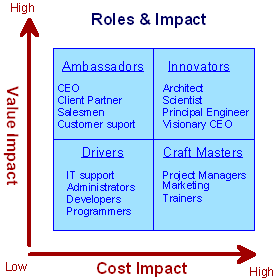
The roles which have the highest value impact These roles almost always command the highest salaries in the organization. See figure-1


On this basis, we can classify an organization’s roles into four broad segments, each of which requires a significantly different talent management approach.

  • Innovators
    These people devise and implement an organization’s distinguishing value proposition or business model. They include principal engineers, chief architect, scientists, etc., in a technology company. This also includes visionaries leader - CEOs, COO, CTO etc., who can innovate new business models and processes. Innovators are scarce resources with skills that take a long time to acquire and are costly to develop and maintain. As a result, they are paid very well and hence have higher cost impact.

  • Ambassadors
    Ambassadors represent the organization’s public face and are responsible for customer experience. Ambassadors can work in all levels of an organization. From the entry level position to that of a CEO. In an IT industry, the common ambassadors are: Project managers, project coordinators, Application support engineers, salesmen, account managers etc. The value impact of these ambassadors is very high - because if they don’t do their job well, the business can suffer significantly. Consequently, these people are paid according to the value impact they have on the business - i.e., CEO, Client partners, Account Managers are highly paid. Whereas front-line employees who are easily replaceable and their skills do not have to be particularly specialized are not highly paid. As a result the overall cost impact if fairly low.

  • Craft Masters
    Craft Masters ensure the quality, timeliness, and cost-effectiveness of an organization — the essential ingredients for the faultless execution of a business strategy. These are the design engineers in a high-tech business, the project managers, the marketing managers, etc.

  • Drivers
    Drivers keep the business running. They are back office operators, programmers, developers, IT support staff, administrative assistants etc. Although they are neither crucial to the success of a venture nor hard to hire, in most companies they represent the largest category of human capital, and bad management of this group can lead to operational disruption or quality problems.
The differences among these four segments are expressed in terms of talent valuation — such attributes as knowledge, experience, skills, and personal interaction capabilities — and not in terms of organizational structures (such as business units) or in human resources management terms (such as age, education, seniority, or compensation).
This concept for strategically managing the value of employees brings human resources approaches to a new level. Basic management processes — sourcing, development and training, compensation, retention, and separation — are conceptually the same for all four employee segments.

However, since each segment differs in how critical it is to an organization’s success, the practical tools used in applying these processes will also differ. Take sourcing, for instance. Depending on a company’s business model and operational plans, employees in some segments, such as Innovators and Ambassadors, are generally hired and trained as part of the permanent corporate head count. In other instances, however, Craft Masters and Drivers are brought on as temporary or contract staff or engaged as independent consultants.

People Management

Once the right people are cast in the right roles, they must be managed according to those roles. For example, consider two training officers, Tom and Dick. Tom is highly professional, and his training efforts are almost always successful; he is a Craft Master. But Dick is more creative and is expected not only to train staffers well but also to improve the quality of the teaching materials. He was hired through a headhunter, is paid more than Tom, and knows that he is depended upon to expand the limits of the training organization. Dick is a Creator. Tom and Dick have the same job title and, in general, do the same work. But Tom and Dick are in separate business critical categories, thus their salaries, evaluations, and promotions must be handled differently.

Closing thoughts

Dealing with employees based on their skills and the roles can be a complex balancing act for management. But it is exactly what every should do. For example, the manager of an opera house must continually handle a number of distinct segments of people: the singers, the conductor, the casting director, the cast, the musicians, the bartender, the box office cashier. To do this, he uses varied sourcin techniques, compensation principles, and motivational approaches in a relatively instinctive way.

But in many cases, the management rules and procedures of an organization can be obstacles to segmentation and a force for "averaging" the treatment of individuals’ roles. This tendency is a dangerous handicap that makes it impossible to measure the value of employees and, ultimately, to compete successfully in the global marketplace.

Also See

Retaining People in Technical Jobs
Retention of top managers
Use Marketing to Hire and Retain Talent

Wednesday, September 06, 2006

Sales - Winning Big Deals

Every salesman know that the future sales can be predicted by looking at the prospects in the funnel. Often times this implies that to meet the number targets, a salesman has to either stuff his funnel with a large number of small prospects or plan on winning a few big deals. On the surface, the obvious choice is to go for the later - aim to win few big customers. But the challenges of winning a big customer is so huge that most salesmen prefer not to chase big customers - instead aim on winning a large number of small customers.

Being a marketing professional, I can vouch that winning a big customer is a challenge and to overcome such a challenge one needs a dedicated focus. Currently I am concentrating on winning a big order from UK’s largest telecom operator. Based on this experience, here are a few tips on winning a big account.

Big Deal is a Big Advantage

To win big you will need a big customer - who has the ability to spend big amount of money and who is also into selling big. Larger companies have larger budgets - its that simple to understand. Often times to win a $1,000,000 deal, the work involved is not 10 times as much as a $100,000 deal. The real effort is only a few times more. Therefore as a salesman, if I were to look at my ROI - winning a big deal is the way to go.

But the challenge is that one needs to be twice as creative and work twice as hard to win a big deal - when compared to an average deal.

Selling to a big company does not mean one will win a big deal

The revenue of your customer has nothing to do with the size of the order you are selling. As a salesman selling IT services to UK’s largest telecom operator, I see that many of the deals we have won are small deals - mostly in $100,000 range or even lower. But these small wins helps me to gain a foothold in areas where we can snag a big contract. I can quote a situation where we entered with a small order for about $120,000 - but that opportunity is now becoming a multi-million dollar deal. Remember: without the small wins, big wins will never happen. In other words, to win big you will need to win small deals.

What the little win does is that it opens the door to another, bigger deal. If you do a good job in the small deals, then you will know the key persons required to win the big deal. These contacts will be your coaches, mentors - secretly working for you within their organization - trying to influence other stake holders. So your chances of winning a big deal greatly depends on winning the small ones first.

Learn to get around the Roadblocks

Big deals also means intense competition and numerous roadblocks. A salesman must know how to get around these roadblocks. In all big deals there will be numerous stake holders and each of these stakeholders have their own agenda and interests to protect. If these stakeholders feel threatened - they will create barriers to your big deal. So the first step is to identify all the stake holders for that big deal, then identify their objectives - both implicit and explicit objectives. Getting around the road blocks involves:

a. Start with building a Business Intelligence System.
See Sales - Knowledge is strength & Marketing - Developing Market Intelligence . I have written about this topic in great details in the earlier articles - so please refer to them.

b. Create a cross functional consultative team. The members of the team must be selected such that each functional member in the buying team has a counterpart in your sales team: An technical architect is paired with customer’s technical architect, your financial manager is paired with the customer’s financial manager, your legal advisor with the contract manager, your business strategist is paired with that of the customer’s strategist etc. The basic idea here is that your sales team should always be in a position to offer intelligent, meaningful consultation to the customer. At any point of time, your team should not be in a position where it cannot answer the customer’s questions. Or in other words - your sales team is now doing consultative selling. See: Consultative Selling - Way to sell Enterprise Software

You, as the salesman must be in charge of selecting the members for this sales team. While selecting team members looks for intelligence and judgment, their capability to anticipate challenges and their ability to work around the obstacles. ( Note that selecting your sales team is not easy. Often times political compulsions may force you to select members who are not the ideal members to have in your team )

c. Be flexible. Often times the vendor needs to be flexible in order to get around the road blocks. One must be flexible and creative with big accounts. You have to do things the way they operate and fit into their process. This implies making exceptions and customization to win the customer. Large companies always expect customization.

Learn How your customer sell to their customer

In other words, treat your customer the same way they treat their customers. Typically any large deal will involve some upfront investments at the beginning. So if your customer is experienced in selling big - or making big deals, then it is beneficial to follow their selling techniques. If they invest in a deal to win a big account, you too should do the same. If they use sophisticated marketing tools: High profile seminars, presentations, sponsorships etc., you too need to do something similar. By mimicking the customer, you are making the customer feel comfortable by making them think that you are also one of them - "Just like us".

Learn how to Close the Deal

Winning big deals depends a greatly on the salesman’s ability to close. Often times, salesmen are reluctant to bring in a closure - because they are afraid that they might lose if they try to close the deal early. So instead, the salesman keeps feeding more information to the customer that the customer now has too much information on hand - and that results in a "analysis paralysis".

Knowing when to push for a closure is an art. It varies with deal to deal, customer to customer. The one way I use to decide on when to push for a closure is called as "50-70% rule". This means that if my probability of winning the deal is greater than 50% and my confidence to the win the deals is about 70%, then I go for it. This is based on my gut feelings and not on experts opinion. Remember that your sales team may recommend against it and they have their "expert" opinion - but experts often lack judgment, So go with your gut instincts

Closing Thoughts

Developing relationships within the customer organization is critical for any deal. By developing relationships inside of large companies, you often have the chance to pursue big deals. To win big deals, one needs a lot more than just relationships - one needs a sales team, business intelligence, flexibility to tailor your offerings and the ability to close the deal. It takes confidence in your selling ability to keep your sales funnel lean and tackle big deal opportunities, but the reward inherent in winning them can be huge. Your sales skills and your organization's flexibility may be put to the test, but big deals can ultimately lead to more stability and growth within your company.

Also Read
  1. Sales - Knowledge is strength
  2. Marketing - Developing Market Intelligence
  3. Consultative Selling - Way to sell Enterprise Software \
  4. Marketing & Sales Funnel