Showing posts with label Invest in India. Show all posts

Friday, February 20, 2015

Policy Changes to Encourage Software Product Development in India


Skilled human capital remains the most crucial factor for software innovation

As software becomes the heart and lifeblood of the modern economy, Software is becoming the driver, an enabler, and a diffuser of innovation across all sectors and industries. For example, look at Uber or Flipkart or BigBasket - which is transforming retail in India and Taxi services.  Software  delivered via mobile devices can transform all aspects of economy - and this is an ABSOLUTE TRUTH!  

India has established as a leader in software services. With millions of engineers, India can emerge as a world leader in software technology.

Unfortunately, India has been a nonexistent player in developing any new software technologies. In areas of core technology development, India has fallen short in a BIG way!

Other countries such as Israel, Taiwan, Korea & China have emerged as product leaders, while India - despite its enormous manpower talent pool has failed to develop world class products and has been playing a secondary role of software services.

Unlike most countries, India does not suffer from scarcity of skilled human capital. India produces lots (quantity) of engineers with adequate skills (quality). Indian engineers have immigrated abroad and have created several product companies. So the problem is not with talent or skills.

The main problem is with the government policy towards product development.

Over the years, Indian government policy has tilted heavily towards software services by offering liberal tax rebates, exception from rigid labor laws, while product developers are penalized with higher taxes, bureaucratic red tape and crippling labor laws.

As a result Indian software companies have largely stayed away from product development. Even
industry majors that set ambitious targets for product revenues have given up their targets over time.

For example, Infosys Technologies, had about 4% revenues from software products in 2001-02, though at one time they hoped to achieve a target of 40% revenues from products by 2000.

Major hindrances in developing products from policy perspective are:

1. Lack of involvement of Indian Private sector in developing key technologies. 

Government run organizations such as DRDO, BARC, CDAC, ISRO work in total isolation during development and only after development, government agencies plan to license new technologies to private sector.

In the USA & Israel, defense development and private sector involvement go hand-in-hand. For example Google got its initial funding from DARPA for a web indexing project.

2. Weak protection of Intellectual Property Rights and rampant piracy. 

When a fledging startup develops a new product and wants to sell to potential customers - mostly large organizations, they are under the risk of piracy. Startups cannot afford to sue bigger companies for piracy as they lack financial resources to fight a long winding legal battle. Laws regarding protecting IPR in India is really strong - but the legal process and bureaucracy causes the hindrance.

3. High cost of Internet & Electricity

Internet speeds in India is very slow and is expensive. The government licensing policy towards allowing private sector to create Internet connectivity from India to abroad has led to acute paucity of bandwidth for International connectivity. In addition, laying cable inside the country is regulated by various state & City government laws - which has made Internet connectivity very expensive.

High cost of 3G & 4G spectrum has also not helped - which has resulted in one of the highest Internet costs among BRIC countries.

In addition, chronic power shortage has forced companies to setup data centers outside India - thus making everyone choke on the slow-speed Internet. For example, it is a lot cheaper to set up data centers in Washington state or in Iceland or Carolina - than in Karnataka or Maharashtra.

For example, If I were to send an email to my wife - both of us residing in the same location, the email is routed via US!

Lack of Internet speed, has put software product developers at a BIG disadvantage. It has prevented Indian entrepreneurs to set up data centers or cloud/Web based or gaming products in India.

4. Lack of Tax incentives for Software Product Companies

Indian Software Services sector has/had several incentives. For a long time, software services were exempt from several taxes! Companies paid no income tax, no import duty, no exercise duty etc. However, product companies have to pay their taxes on day one!

This skew in tax regime has led to Indian entrepreneurs opting to invest in software services, which minimizes risks and maximizes profits. With services, entrepreneurs can expect to break even or even make profits in the first year of operations.

Providing Tax incentives to software product companies will help make India become a product powerhouse.

5. Lack of incubation centers and investment in early state startups

Early stage startup in India have to overcome several challenges: Lack of office space and investments for product development. In recent times, Venture Capital firms have been active in India, but they do not provide funds for an early stage startups. There is a need to create an 'Angel Funds' - which must be provided by a Government agency. In the US, Government releases funds to early stage startup via DARPA, DoD and  other organizations.

Conclusion


Prime Minister Modi's "Make-in-India" pep-talk must be backed by policy changes to help Indian companies and entrepreneurs develop software technology products in India - for the world.

Changing the existing Tax regime and Internet policies will help in a BIG way to develop software products in India!

Friday, August 22, 2008

E-Learning has huge potential in India

India celebrated its 61st Independence Day on August 15, 2008. Even after 61 years, a large section of the population does not have access to proper education. Barring the top schools under ICSE/CBSE system, the IIT/IIM/NIT/IIIT and few other elite universities, the education standards in rest of schools & colleges are poor. The need of the hour is to build a cost effective education system – which can deliver the best quality education system like that of the elite schools but at one tenth the price.

When I look at the challenge, I can see the answer in e-Learning. But then e-learning is not the right answer. E-Learning has been around for quite some time now, and is yet to make the mark. So what is that we are missing? This question got me thinking, exploring and brainstorming.

E-Learning in India

E-learning in India is miniscule when compared to traditional learning. E-Learning is limited to select few elite universities/colleges and top-100 Indian companies. (Plus fortune-500 firms that operate in India.) The amount of money invested on E-learning by top-100 firms is negligible when compared to the instructor led trainings. In the academic world, E-learning is almost non-existent.

This dismal picture hides the real potential of E-Learning and also reveals the reasons for the failure of E-Learning.

Challenges to E-Learning

E-Learning has not taken off in India for several reasons that range from faulty technology to government regulations.

The failure of E-Learning can be greatly attributed to wrong technology. The current PC & Web based technology is not suited for Indian conditions. The current technologies used in E-Learning were all developed in America – and is not suitable for India & other developing countries.

The technical barriers to E-learning in India are as follows:
  1. Low Computer Penetration
    India has very low computer penetration. Currently only 2% of Indian population has computers at home. This means that e-learning via PC will be a non-starter.See: http://dqindia.ciol.com/content/50yrsIT/Perspective/2006/106123008.asphttp://dqindia.ciol.com/content/50yrsIT/Perspective/2006/106123008.asp

  2. E-learning is based on computer platform with broadband Internet

    Coupled with low computer penetration, the high price of Internet broadband & non availability of broadband in many parts of the country implies that very few people can access E-Learning content that is being created.

  3. Technology Barriers.

    Today’s LMS platforms used in E-learning are quite complex. The users are expected to have basic computer skills to operate. Given the fact that the entire audience for e-Learning is there for basic education – the current e-Learning platform is totally failure for the intended audience.

  4. Language barrier.

    Probably the biggest drawback of today’s e-Learning technology is the language – All the current e-Learning platforms & content are based on English language. Though India has a huge English speaking population – the target audience for basic education via e-learning are not proficient with English and with computers.

Technical barriers are not the only thing that is pulling back e-Learning. Apart from the technical barriers, there are business use case problems to deal with.

  1. Faulty Business models.

    The current technology requires deployment of Learning Management Systems (LMS) running on a central server. The users have to log in via Internet or Intranet to access the programs. Reliable LMS software are expensive to license – it is about $25 to $100 per user per year (depending on the number of users), in addition there is need for several other software: database, web server, security systems etc. Plus there is the cost of licensing the learning content. The total cost of the systems & software itself has to be amortized over the number of users. This business model will work in a corporate environment where companies have proprietary content and are willing to foot the bill for e-learning system.

    The current e-learning business models are best suited for corporate firms – where the users are not cost sensitive & users have sufficient computer skills. This model however is not suitable for a large scale deployment that will be required in an Indian scenario.

    E-Learning has been successfully deployed in some of the universities abroad – mainly in the US & Europe, but here the cost was not a major factor.

  2. Outdated government rules & regulation

    Education system in India is governed by various governmental agencies. These agencies follow archaic rules that are designed to extend government control and prevent any form of innovation. The current rules do not exactly prevent e-learning, but the system does not encourage e-learning either.
  3. Cultural mores and norms
    Culture in India also hinders e-learning. The society considers classroom learning as “REAL” learning and any other form of “distance” learning is essentially second rate. As a result, people are naturally discouraged from opting for e-learning. On the contrary, Indian Universities have developed and promoted distance education – mainly through correspondence courses. These courses are offered only for higher education – as a substitute for college/university education.
Closing Thoughts

E-Learning has a big potential in India given the huge population base and the rapid growth of the economy. However there are quite a few obstacles to be overcome. This article describes the problems which prevent e-learning from taking off. In the subsequent articles, I will talk about the possible solutions and the changes needed to make quality education accessible & affordable for all.

Tuesday, August 05, 2008

Encouraging Young Innovators

Today I read a news item on Google News that a group of engineers at RV College of Engineering in Bangalore have developed a car with ultra high fuel efficiency of 180 Km/liter of petrol or ~410 Miles/Gallon!

I guess that this would be some sort of a record. I congratulate this team of young innovators.


See: RVCE launches Garuda supermileage car

Wait! Don’t get all too excited to buy this car. This is just a prototype – technically it’s a car, but it is not really a people transport worthy yet. But that issue is not what I am concerned about. Instead I am very happy to see how many local companies jumped in to help these engineering students develop such a prototype: Tantra Infosolutions, CA Adapco, Chameleon Motors, Innoversant Solutions and Bimal Auto Agency.

What amazed me is that all these companies are local to Bangalore & have nothing to gain from the success of the project (except for PR & brief publicity).

The raise of Indian engineering and Innovation can be seen with this small success. For a long time, Indian educational institutes and industry complained about lack of Industry-education cooperation. But this is now changing – albeit slowly but surely changing for good.

Indian industries & business should join hands with colleges and universities to build innovation in India that meets the needs of its people. Garuda experiment shows how one can succeed with cooperation. Most importantly, Garuda project shows how one can encourage young innovators who are studying in universities.

Tuesday, December 18, 2007

Tata’s EKA will usher a new computer revolution


A month ago world was surprised by Tata’s EKA - the world’s fourth fastest super computer built by Computational Research Laboratories (CRL) ), a wholly owned subsidiary of Tata Sons.
For the first time in the world, a private company which has no experience in building computers - let alone high performance computers(HPC), has ever build such a computer. The story of EKA’s development will be good innovation casestudy.

"CRL's supercomputer, EKA, has put India at the forefront of high performance and supercomputing technology globally. EKA gives us the ability to address applications in multiple disciplines including software development and research," said S Ramadorai, chairman of CRL and CEO and MD of Tata Consultancy Services. "The successful launch of the supercomputer has been driven by an exemplary team at CRL working collaboratively with scientists across the Tata Group."


Tata Industries have always demonstrated their risk taking abilities and their vision for the future. With EKA, Tata’s have heralded a begining in the era of super computing for the masses. EKA can provide an ideal platform for Tata Consulting Services (TCS) to offer high performance computing services - The opportunities in this space is estimated to be about $31 billion. EKA opens the doors for TCS to offer a wide range of services in terms of:


  • HPC consulting, (HPC - High Performance Computing)

  • HPC Software development,

  • Outsourced Product development

  • Data center management,

  • Remote Infrastructure management

  • Grid Computing or Offer computing power as an utility

  • Build, sell & maintain super computers for other agencies.

Having demonstrated such a spectacular success, Tata’s should now capitalize on it. India can become a center for offering super computing services.


IBM, Google, Yahoo, Amazon and few others are contemplating on offering Grid computing, TCS or Tata’s can join them in doing the same by selling computer power to corporations, R&D labs and government agencies all over the world.


Selling massive amounts of computing power is made feasible by Tata’s VSNL, a long distance telecom company, that is built the largest undersea fiberoptic network - to carry all the needed bandwidth.


This is just the begining of Indian Innovation powers. Indian Innovation and Entrepreneurship will be the key driver of the global economy in the 21st century.
Congrats & Thankyou to all the team members who developed EKA.

Also See:


http://www.tata.com/tata_sons/releases/20071113.htm
Google and the Wisdom of Clouds

Wednesday, January 31, 2007

Why Invest in India - Natural Gas Distribution


Natural gas is a fossil fuel of choice for domestic use: heating & cooking, for generating electricity and for industries in the USA & Europe. But in India, the use of natural gas has lagged behind the demand for decades. Mainly due to government monopoly over Natural gas distribution through GAIL. Due to this monopoly, gas fields in India are undeveloped and natural gas is under used in all segments of economic activity. The map shows how little the government has developed the gas transportation network - the current network touches only 10-15% of the total customer base.
The use of this clean burning fuel has so much latent demand - that new investors can tap easily into this demand and reap rich benefits.

The fast paced growth of Indian economy and the need for energy has led to deregulation of gas distribution business. The state monopoly has been dismantled by allowing private companies to setup new pipelines. Reliance Industries Limited is now building an East-West pipeline to transport the gas from its gas fields in the east coast of India to Gujrat and Northern India. RPL is also building a pipeline to connect its gas fields to the southern city of Chennai.

Government is also considering private investments to build pipelines from Russia, Central Asia, Iran to India. Another proposal is to build pipeline to ship gas from Myanmar to India and another pipeline to transport gas from Bangaldesh to India. Tata’s were in talks to build this pipeline - but it later withdrew from the negotiations owing to political bickering in Bangladesh and the local Anti-India stance of Bangladeshi politicians.


While the cross-border pipelines carry high political risks, they also promise a very high returns. This kind of investments are ideally fit for Fortune-50 type(Exxon-Mobil, Shell, British Gas, Texaco etc) companies who can leverage the influence of US/UK governments to protect their investments.


Local Demand

The local demand for natural gas is very high - provided the costs of transportation is worked out. The use of natural gas as fuel for automobiles, cooking and industries in cities is a huge untapped demand. The key to tap into this untapped market is to build a city distribution pipeline. Large metropolitan cities of India: Ahmedabad, Hyderabad, Chennai, Delhi, Kolkata and Pune will be connected with transportation pipelines. Additional investments in a city distribution pipelines will enable companies to tap into this huge untapped demand.


Another potential latent customer is the electricity generation units - basically new units which will be setup in the coming years. Since India is poised to setup power plants to generate 100,000MW - the demand from such plants will be huge. Existing industries such as metals, fertilizers, chemicals etc are also potential customers.


Closing Thoughts

Investing in gas distribution and transportation business brings huge returns. But this also involves building an influential lobby with the government and tie ups with the production companies - ONGC, Crain, RIL, GSPC, Essar etc. For global energy players (Shell, British Gas, Texaco, etc), a JV with an existing company which has proven gas reserves will create a synergy for both entities to reap rich dividends.
Also See:

Why Invest in India - Electric Power Infrastructure


In my previous blog I had written about the opportunities for investors in Electric power generation sector. The Government of India has woken up to the need for investments in power distribution and transmission sector as well. As a first step, the government plans to disinvest 5% of its equity in three power distribution companies: Power Grid Corporation, Rural Electrification Corporation, and National Hydroelectric Power corporation.

This is a very significant move by the government. This implies that the workings of these public sector companies will now come under the scrutiny of the private share holders and eventually private participation in management of these companies will be seen.

Realizing the need for private investments in power generation, transmission and distribution, the government of India is ending the monopoly of its power distribution business in April 2007.

Taking an early lead in exploiting the reforms in power transmission & distribution sector, Areva T&D India Ltd has worked with NTPC to setup a 765KV switchyard for 3000 MW power plant at Sipat in Chhattisgarh. Areva T&D India Ltd partnered with NTPC in constructing and maintaining a cutting edge technology switchyard.

This collaboration is an important milestone. This signifies how private sector can work in the power generation, transmission and distribution business in India. As India continues on the reforms path in electric power, more opportunities will open up for private investors to tap into the growing market for electric energy in India.

Tuesday, January 30, 2007

Why Invest in India - Aviation Sector

In my earlier blog I had written about the opportunity for investors in Indian aviation. The rapid growth in the number of air travel - has caught the attention of the civil aviation ministry. Privatization of airports, creation of SEZ (Special Economic Zones) dedicated for civil aviation sector and liberalization of foreign investment policies - all points towards the growing opportunities.

This message has been seriously taken by the global leaders in civil aviation. Boeing and Airbus Industries are establishing Maintenance, Repair and Overhaul (MRO) facilities in India. Boeing is setting up a center in Nagpur, while Airbus is setting up a MRO in Nasik. Both the companies are negotiating with HAL for setting up manufacturing/assembly facility in Bangalore. The state government has announced a creation of SEZ in Bangalore - which has an exclusive focus on aviation. GE Aircraft Engines, Pratt & Witney, Bell Helicopters, ATR will be setting up manufacturing facilities, R&D centers, and maintenance centers in India - probably in Bangalore.

The rapid growth in Indian civil aviation has created huge opportunities for support services. Indian Airlines is planning to offer ground handling and engineering services to other private airlines as well. Kingfisher Airlines has outsourced its ground handling and engineering services to Indian Airlines for a period of two years. This implies that other service providers in USA and Europe etc., can invest in India to tap into this service segment - and offer MRO services to all other airlines in the South Asian region - from Singapore, Indonesia, Malaysia, Sri Lanka to Kazakhstan. This market potential is huge.

The growth in air travel has now created a huge demand for other forms are air travel and business: Charter planes, Charter helicopters, sea planes, Cargo operations, etc. Government of India is in the process of changing the rules which will encourage foreign investors to enter into the other aviation business of charter services, part ownership of private planes, aviation training centers etc. With the growth in American and European air travel being stagnant (or negative), Foreign companies are eagerly looking into Indian skies. Lufthansa has already announced an aggressive investment plan in India - and wants to expand its range of services in India. British Airways and Virgin are also actively looking at ways to expand the range of services that they can offer in India.

Closing Thoughts

The world’s interest in Indian aviation can be gauged by the number of companies coming to India for "Aero 2007". This trade event is the biggest air show in Asia, and the second largest air show in the world! If the air show grows in popularity at the same rate, Aero 2009 will be the world’s largest aviation trade fair in the world - and by then India would have truly emerged as a global power in the world of aviation.

Also See:

Why Invest in India - Power Generation Infrastructure
Why Invest in India: Innovation & Creativity
The Great Indian Renaissance. Written by Dr Manmohan Singh
Why Invest in India: Resurgent Economic Growth in 2007
Why Invest in India - Banking
Why Invest in India: Booming Air Travel Industry
Why Invest in India?

Saturday, January 20, 2007

Why Invest in India - Power Generation Infrastructure


Indian economy is going through a period of remarkable transformation. Economic growth is now reaching 10% mark. In the last 15 years - it has been IT sector which has led India’s economic transformation. But in the next decade, economic growth will be led by infrastructure development companies. The growth in India’s infrastructure is inevitable today. As the economy grows, the current transportation infrastructure: Roadways, railways, airports & seaports are in need of rapid expansion to support a sustained economic growth. Government of India has realized the need for investment and is inviting private companies to invest in the infrastructure space. The need for private investments in transportation & energy sector is very acute.

Energy sector - Electricity


India now needs investments to setup new power plants - 100,000MW of additional capacity by 2010.

Taking this as a clue, several companies are investing in infrastructure space. These investments are mainly greenfield ventures where the risks are high - but so is the payoff. Enron was one of the first foreign investor to invest in the energy sector. Enron ventured into India with a greenfield power plant in the state of Maharashtra. However, Enron had not planned for handling the Indian politics and dealing with Indian government. Coupled with its inexperience and the following political controversy - forced Enron into bankruptcy in India.

Enron’s failure has not deterred other investors in power sector. Tatas & Reliance groups have invested in power generation and distribution in Maharashtra - the very state where Enron had failed.

Reforms in Indian Energy sector and the critical shortage of power in India has attracted several new players to invest in India. Continued energy sector reforms in 2007 will aid the rapid growth of this industry. By April 2007, private sector will be allowed to enter into power transmission and distribution business.

Companies like GMR, GVK, Lanco, Suzlon, Graphite India, AV Birla Group, Essar, and whole lot of companies are on an investment spree. The spurt of private investments does not mean that foreign companies do not have opportunity in India. On the contrary, these very Indian companies are eager to tie-up with foreign firms and expand in India. The need for capital, technology and business experience drives Indian companies to look for collaboration with external investors.

Supporting this massive growth in power generation, opportunities are now opening up in manufacturing sector. The demand for power generation equipment, power transmission equipment etc., is also very high. Currently Indian market for power generation equipment is dominated by local companies: BHEL, Triveni Engineering, etc., and a few MNC’s such as ABB, Shnider Electric etc. But as the demand grows - particularly in Nuclear power plants, opportunities for new entrants will be very high. Indian government is looking forward to see companies such as Westing House, Hitachi, GE and others to invest in India to build/Sell nuclear power plant equipment. The recent agreement on nuclear cooperation between India & USA has created an advantage factor for American firms to tap into Indian market in civil nuclear energy space.


Potential Risk Factors

The biggest risk of investing in power sector are the political risks. Since power is on the concurrent list - i.e., the administrative & regulatory authority in electricity generation, transmission & distribution is governed by two sets of laws:- Both the State governments and the Central Government. This makes it difficult to expand operations beyond one state, and takes a longer time to clear all the regulatory hurdles. Government still has a monopoly over power distribution networks and provides adhoc subsidy for farmers - these subsidies are often unfunded and power distribution companies have to take a hit on the profits.

Another bigger risk in power sector is shortage of raw materials: coal, natural gas & other hydrocarbons. Coal mining is a state owned monopoly of Coal India Limited - where corruption in coal supply has ensured that mafia controls the distribution of coal in India. Private electricity generators using coal as fuel will either have to oil the political machinery and the mafia to ensure coal supplies or rely on imported coal. The supply of natural gas is also a monopoly of the government and the pipelines to distribute natural gas to all parts of the country does not exist. This implies that power generation plants will have to build the infrastructure needed to get adequate supply of natural gas.

A side effect of monopoly in energy raw material supplies (coal & Gas) has created a situation where these monopolies operate with little regard to efficient transportation. This implies that power plants must build a huge buffer stock to overcome any disruption in supplies. Often times, it is cheaper to import coal & gas rather than rely on government monopolies.

Closing Thoughts

Economic reforms in India are now touching the power sector. Given the high growth rate of Indian economy - the demand and the shortage of power has skyrocketed. Continuing reforms is ensuring that private players are being encouraged to enter the power sector. The potential for growth and wealth creation in power sector are enormous - as seen in telecom sector. Reforms usher in new wealth creation opportunities for those willing to take the risk of being an early entrant. Power sector is now being primed for a massive expansion - and wealth creation.

Also See:

Saturday, January 06, 2007

Why Invest in India: Innovation & Creativity

India has now regained its innovative spirit. As a result, creativity can be seen in all walks of life in India. In the post license raj era, Indian companies have discovered the benefits on innovation and creativity. Sectors such as software, computers, microelectronics, automobiles, Aerospace, telecommunications, biotechnology, Medicare, pharmacy, entertainment, construction, heavy engineering and others have greatly benefited by the spirit of Indian innovation.

India has a long history of creative thinking and Innovation

Barring the dark ages of the British rule, India has always been the hub of innovation, invention and creativity. Creativity in India can be seen in diversity of its languages, classical arts and music, literature, folk arts, construction etc. To highlight the historical fact of Indian creativity consider this: India has five forms of classical dances, two forms of classical music, four major religions of the world originated in India, twenty five languages - kanada and telgu being the most developed languages. ( In these languages, what is written can be exactly spoken - i.e., there are no tones, or silent letters etc.). And that beats any other country in the world. (i.e., no country in the world can boast the same)

Unfortunately during the British rule, the very foundations of Indian creativity were disturbed. The traditional education system - the "gurukuala" was destroyed. The ecosystem for innovation was destroyed. And that resulted in the dark age of Indian innovation. Yet the culture of innovation survived and is now coming back with a great force.

India has now rebuilt its innovation ecosystem

The culture of innovation comes from the attitude of people and the work environment. On a broader scale, it is dominated by the economy, external environment and the support infrastructure. The policy of the government and freedom are probably the biggest factors that contribute towards this cause.

A strong pillar for innovation is capital: Both human and money.

One of the earliest acts of the newly independent India was to create the foundation for scientific and engineering education. Over the last sixty years, India has built a strong and a robust educational system - which now graduates millions of students every year.
Indian stock market and democracy has taken deep roots in the society. Reliance Industries Limited (RIL) was one of the first companies to use the strength of Indian capital markets and build the world’s largest petroleum refinery. Earlier RIL created the world record by having the largest number of individual shareholders for any single company - a feat unsurpassed by any company till date. Having a strong capital markets is essential for innovation. Suzlon, Dr. Reddy Labs, Ranbaxy, Cipla, Biocon, Barth Forge etc, all have tapped into the strength of Indian stock market to raise the required capital for their business enterprise.

Government policy and research assistance in form of large R&D centers, PSU, organizations have created the necessary infrastructure to capitalize on for further innovation. ISRO, BARC, IISc, IITs, CPRI, etc., have become incubation centers for innovation. To highlight the value of Indian research centers consider the mission statement of Society for Innovation and Development (SID) at IISc:

"The mission of SID is to enable India's innovations in science and technology by creating a purposeful and effective channel to help and assist industries and business establishments to compete and prosper in the face of global competition, turbulent market conditions and fast moving technologies. SID strives to bring the leading intellectuals of IISc and the fruits of their research and development efforts closer to industries and business establishments in a cordial atmosphere with prosperity of the Nation as the ultimate goal."

Indians will invent, innovate and create

Unlike Europeans or Americans, Indian approach to innovation, invention and creativity has been very different. Indians tend to opt for cost effective innovation - without wasting capital or resources.

Indian advances in space technology, nuclear science, IT, computers, Automobiles, pharmacy, manufacturing etc., have repeatedly shown that invention in India costs a fraction when compared to USA or Europe. Mahindra & Mahindra developed its best selling SUV - "Scorpio" at one-tenth of what it would have costed Ford or GM to develop a similar vechile. "Saras" - a passenger plane developed by NAL costed only $11 million!

Indian penchant for cost effectiveness is demonstrated in its innovation culture. As a result, the world is now turning to India for all creative work.

World now turns to India for creative work

Some of the biggest brands in the world - like Coca-Cola - are now turning to Indian creative types to manage their online advertising campaigns. What's more, even luxury brands are no longer deterred from using Indian talent, as this example using Alfred Hammel illustrates:


"Typical of ad outsourcers is niche luxury brand Alfred Hammel, which pitches $10,000 Swiss watches to Americans and Europeans in tony magazines and newspapers. Looking to cut marketing production costs, two years ago the New York-based company handed its ad account over to Banerjee & Partners, an agency specializing in outsourcing work to India.

The watch company's president, Gurbakhsh Sethi, meets with Banerjee staff in New York to plan strategy and sign off on designs, slogans and creative ad themes. Behind the scenes, Banerjee's staff in Bangalore, India, does art direction and color correction on the photos, which were shot in New York. The finished work is sent back to New York over the Internet. Dave Banerjee, the agency's founder, says his U.S. team, which works in morning and afternoon shifts to take advantage of the time difference, works closely with the Indian team throughout to process "to ensure that the work reflects the right cultural nuances."

The bottom line appears to be cost savings: according to the Wall Street Journal, some firms in India charge as little as one-eighth of what it might cost in the U.S. Add to that, Indian firms are becoming more sophisticated, especially when it comes to rolling out online campaigns that can really leverage world-class Indian technology talent.

Even the Chinese firms: Lenovo and Heuwai are establishing R&D centers in India. (see: http://www.siliconindia.com/shownews/34519 )

Cisco is shifting 20% of its workforce to India. (By shifting, I mean Cisco will hire more in India and also encourage other employees to relocate to India). See: http://www.deccanherald.com/deccanherald/jan82007/business223331200717.asp

Closing Thoughts

The great brain drain from India in the 1990s was stemmed after the dot-com bubble burst at the end of the last century. Much of that talent has now returned to India and is being used to grow India's contribution in pharmaceuticals, telecom, and software. Ideas, manpower, and money add up to tremendous innovation occurring in the country right now.

Global business giants have realized the innovation potential in India and have started investing in India. IBM, GE, Microsoft, Cisco, Intel and sixty other top innovating companies have already setup their R&D centers in India. These investment will further create an experienced talent pool which will inturn attract the best talent from other parts of the world as well. Companies investing in India for establishing their R&D centers will reap rich rewards through creating of innovative products and solutions.

Also see:

The Great Indian Renaissance. Written by Dr Manmohan Singh
Why Invest in India: Resurgent Economic Growth in 2007
Why Invest in India - Banking
Why Invest in India: Booming Air Travel Industry
Why Invest in India?

Monday, December 25, 2006

The Great Indian Renaissance. Written by Dr Manmohan Singh

Here is an excellent writing by the Prime Minister of India Dr. Manmohan Singh. This article was orginally published in "The Week" Magazine. You can read the orginal at: http://week.manoramaonline.com.


I am delighted that THE WEEK is celebrating its silver jubilee. I am also happy that you have chosen for your anniversary issue the theme 'Indian renaissance'. India has experienced a renaissance of sorts in the last 25 years. After the initial burst of energy and enthusiasm in the early years after Independence, during which India broke decisively from over a century of lack of development and progress, the country passed into nearly two decades of crisis and slower growth.

Taken together, the 25 years during which THE WEEK has been in print have been a period of great creativity and enterprise in our country. This has been so not just on the economic front but also on the social and cultural front. The enormous growth of the media in these 25 years is just one instance of the burst of creativity and energy at home. New businesses, trade, arts and crafts have come up. And so have new social and political trends and tendencies.

Today, in two vastly different spheres of human activity we see a new India. One is the world of business and the other the sphere of civil society. Few of the top 100 business groups in the country today existed in 1981. As I observed recently at a media event, not only were none of the awardees for excellence in business in two different businesses 25 years ago, but even their lines of business did not exist as an area of business activity 25 years ago. Thus, we have seen a renaissance of sorts in the important area of creativity and enterprise.

The second striking phenomenon of the past quarter century is civil society activism. India has become the NGO capital of the world. Across the length and breadth of the country, I find highly motivated and talented young women and men engaged in a wide range of social and developmental work through NGOs. Many of them have had good education and could have pursued highly remunerative careers not just in our major cities, but in some of the biggest cities of the world. Yet, they chose to work in distant villages, educating and empowering Dalits, tribals, women, children and other oppressed or disadvantaged sections of society. Many others have taken the benefits of modern science and technology to remote areas, economically empowering marginalised groups.

These two vastly different phenomena, in two very different walks of life, have given India a new visibility in two different worlds-that of the world economic forum and that of the world social forum. The reality of India is captured by this diversity.

The 'Indian renaissance' is also reflected in the burst of intellectual energy that we find in the world of literature, art and cinema. India publishes more books than most countries in the world. It was not, therefore, surprising to see India being the toast of the World Book Fair in Frankfurt earlier this year. Indian cinema has made its mark and so have Indian artists whose works are selling at rising prices the world over.

All this symbolises the new energy of a new India. However, there is a long road ahead. The backlog of poverty, ignorance and disease continues to hold India and Indians back. We have to invest more in education, health care and labour-intensive sectors that generate employment, and so on to bridge the development divide in India. No nation can boast of a renaissance, much less a resurgence, if half the population is illiterate or semi-literate.

Our dreams of building a 'knowledge society' will come to nought if all our children are not in school, do not get a healthy meal and do not have the opportunity to improve their economic lot and social status through education. Universal and modern education, based on what Pandit Nehru used to call a "scientific temper" and the values of liberalism and pluralism, is therefore a necessary precondition for a more broad-based renaissance.

We must also pay more attention to the social and political causes of violence and lack of social peace in our neighbourhood. India cannot develop and move forward if it lives in a region of economic and social backwardness. India's destiny, as indeed India's heritage, is shared with its neighbours. The values of liberalism, pluralism, the rule of law, equality of all ethnic groups, religious communities and linguistic and social groups and, above all, a rational outlook based on a modern and scientific temper must pervade all of south Asia so that the region as a whole can prosper and live in peace.

What has truly contributed to India's social and cultural development is the pluralistic nature of our open society and economy. As a multi-cultural, multi-lingual, multi-ethnic and multi-religious nation, India has created a wide space for the full expression of human creativity and ingenuity. It is in this diversity, this plurality and the inherent unity of the Indian psyche, so brilliantly captured in the idea of Vasudhaiva Kutumbakam [the world is one family] that we find the roots of the Indian renaissance.

I hope THE WEEK is able to convey this idea to all its readers through its columns week after week. I wish you success in your noble endeavours and wish all your readers a Happy New Year.

Why Invest in India: Resurgent Economic Growth in 2007

In this continuing series of "Why Invest in India", I found a very interesting article in an Indian Magazine "The Week".

The text of this article is given below. Readers can read the orginal article at: http://week.manoramaonline.com/

India expects to forge ahead in 2007

Barring sudden disasters, India will welcome the New Year in a satisfactory frame of mind. Considering the alarming conditions in several parts of the world - the Middle East for instance - India can claim to have earned the blessings of providence to be reasonably well placed at the moment.

The economy is chugging along at a brisk pace. The deficiencies, mainly in agriculture, have been recognized, even if belatedly, and Prime Minister Manmohan Singh has promised redress. If tackled imaginatively, this sad chapter in the nation's life, highlighted by farmers' suicides, should come to a close.

In politics, the scene is much better. The earlier fears about the durability of coalition regimes have been largely dispelled. The multi-party alliances run by Manmohan Singh, and by Atal Bihari Vajpayee before him, have proved to be relatively stable, notwithstanding the presence in them of small regional parties with their narrow caste-based provincial attitudes.

As if to cap the good news from the economic and political fronts, the India-US nuclear deal has emphasized India's unique status in the world. India is now the only country that has been accepted as a legitimate nuclear power although it not only refused to sign the non-proliferation treaty (NPT) but tested nuclear weapons in 1974 and 1998 in defiance.

This new shining image of a "nuclear" India is in striking contrast to countries like Pakistan, which is suspected of having had a hand in the black marketing of nuclear technology, or North Korea that is regarded as a rogue state, or Israel that is believed to have a secret nuclear arsenal, or Iran whose nuclear programme is a cause for worldwide concern.

There are several reasons why the US and the world have chosen to overlook India's transgressions of the nuclear protocol. One is its responsible behaviour even after going nuclear to register its principled opposition to the NPT, which arbitrarily divided the world into nuclear "haves" and "have-nots".

The second is its robust economy that has removed all doubts about India's emergence as a regional superpower.

And the third - and perhaps most important - reason is its remarkably successful democratic experiment in a country with 4,635 communities speaking 23 major languages, including 17 "official" ones, 22,000 distinct dialects, 85 locally or nationally important political parties and, last but not the least, with 300 ways of cooking the potato.

Considering that Charles de Gaulle had wondered how a country like France could be kept together when it produced 265 varieties of cheese, it is not difficult to appreciate the extraordinary nature of India's achievement.

What is also noteworthy is the growing belief that just as Indian democracy has smoothened the rough edges of a diverse society, it has also taken out the sting from the rapid economic progress via the route of market economy.

While Reuters has noted a dramatic rise in the number of riots in autocratic China from 10,000 in 1994 to 74,000 in 2004, India has been relatively free of the social tension caused by the growing disparity between the rich and the poor, which is an inevitable early fallout of "neo-liberal" economic policies.

It is not that there haven't been protests in India. The latest such resistance to the official encouragement of capitalist strategies is in Singur in West Bengal, where the main opposition party is up in arms against the acquisition of fertile agricultural land by the Tatas for a small cars factory.

Earlier, similar industrial ventures involving farmlands in the neighbouring state of Orissa by the Tatas and the South Korean steel giant Posco led to police firing and deaths of tribal demonstrators.

The setting up of Special Economic Zones in nearly all the states providing tax relief and other incentives to domestic and foreign investors has also attracted protests from the opposition parties. But while news of the unrest in China trickles out after a considerable lapse of time, the protests in India are played out in full view of the television cameras and media personnel.

The pros and cons of these contentious developments are also discussed threadbare in parliament, state legislatures, public forums and television and radio studios. The result is that the lid is taken off a volatile situation. Therefore, it rarely boils over into widespread violence.
This is not India's only saving grace. What has also ensured social harmony is the fact that the governments of all hues, ranging from West Bengal run by the Communist Party of India-Marxist to Gujarat under the Bharatiya Janata Party, are all eager to make the most of the economic upsurge. As a result, they all value the market economy, which is normally the bugbear of the dogmatic Left and also evoke the ire of the protectionist Right.

Given these factors, it may be safe to predict that 2007 will give a more definitive direction to
India's policies in several fields - economic, political and foreign affairs. While pro-capitalist policies will lead to the burial of "socialism", a two-coalition system is likely to evolve with the Congress-Left alliance on one side and the BJP-Janata Dal-United on the other.

At the same time, the presence of a large number of smaller parties acting as allies will prevent the two major coalitions from adopting extremist postures, thereby ensuring the pursuit of moderate policies.

In foreign affairs, India's growing proximity to the US will be the final nail in the coffin of the cold warriors in both New Delhi and Washington. But America will also realize that India is too large and too boisterous a democracy to endorse whatever the US may say. In this respect, the tradition of non-alignment will survive.

And the icing on the cake may well be an understanding with Pakistan on the basis of the suggestions made by both Manmohan Singh and Pervez Musharraf about making the Line of Control (LoC) in Jammu and Kashmir irrelevant.

Also see:


  1. Why Invest in India - Banking
  2. Why Invest in India: Booming Air Travel Industry
  3. Why Invest in India?

Why Invest in India - Banking

Banking sector is the best performing sector in Indian economy today. With the economy growing at 8.6%, the need for banking services is growing at 34% - no wonder many foreign banks are eager to expand in India. Few days ago I had written about stock investments in two leading banks in India: ICICI Bank & HDFC Bank. The performance of these banks can be taken as indicators of the growth opportunity that exists for banks in India.

Global Banking Giants have got a Foot hold

India liberalized banking sector in 1990’s - albeit in a limited way. Foreign banks still have to follow a myriad set of rules and regulations to establish in India. But this has not prevented Citi Bank, HSBC, ABM Amro, Standard Chartered from setting up retail banking operations in India - Citi & HSBC banks are way ahead in setting up retail operations in India when compared to other foreign banks.

Time is ripe for Global Banking giants

Retail banking in India is dominated by State owned banks - SBI group, Canara Bank, Punjab National Bank and a whole lot of other banks. These banks are lack the entrepreneurial sprit - and are very conservative in their operations.

As a result consumer loans constitute only 8% of total bank lending in India, compared with 36% in Taiwan and 58% in South Korea, according to Enam Securities in Bombay. Mortgages, meanwhile, form a mere 2% of gross domestic product in India, compared with 17% in Malaysia and 51% in the U.S. (Source: Wall Street Journal 2006)

Another result of such conservative banking: most Indian companies do not use bank credit as a means of financing.

This has created an ideal situation for global banks to setup operations and rapidly gain market share by serving the customers - who are unserved by the public sector banks: Consumers, Rural/Agriculture, entrepreneurs etc.

Another very good reason for foreign banks to come to India is Economics of Scope. Major customers of these banks abroad have setup operations in India. MNCs such as GM, Ford, Volkswagen, Daimler-Chrysler, IBM, SUN, HP, Cisco, Intel, Microsoft, BASF, AOL-TimeWarner, GE and several others need banking services in India and they are now forced to use local banks or other banks rather than their main banks at home. Global banks need to expand in India to serve their long standing corporate customers in India.
The opportunities in India are immense: starting from corporate banking, SME, Retail banking, consumer finance, and micro finance. Currently, most foreign banks are concentrating on corporate banking only - but the real opportunity is in retail banking and consumer finance.

Giants Waiting to Expand

Indian growth story is not lost on the global banking giants - particularly European banks. Led by HSBC and Standard Chartered, European banking giants are eager to make a big splash in 2007. Deutsche Bank, Barclays, ABN Amro, BNP Paribas and Societe Generale have announced big investment plans and budgets for 2007.

Macquarie Bank from Australia, Development Bank of Singapore, Citi Bank, and Bank of America have also announced major expansions in 2007. In total 37 foreign banks are currently operating in India with 217 branches ( most banks are operating in a very limited way).

Compared to China, Banking sector in India is much more open in India. Foreign banks can enter India through wholly owned subsidiary or via joint venture. In case of a JV, foreign investors can own upto 74% of the equity. India has about 37 foreign banks operating in India already. In China, by comparison has none. Only in December 2006, Chinese government gave permission to nine foreign banks to start operations in mainland China. (HSBC, Standard Chartered, Bank of East Asia, Hang Seng Bank, Mizuho Corporate Bank and Bank of Tokyo-Mitsubishi UFJ, DBS Bank, of Singapore; and ABN Amro)

Closing Thoughts

Banking is one of the essential tools of capitalism. With Indian economy opening up and booming the time is ripe for foreign banks to expand and establish in India. Apart from banks, opportunities are there for non-banking finance operations - such as GE Finance, Citi Finance which are primarily engaged in consumer finance.

European banks have taken India seriously and are planning on massive expansion in the coming years. A notable aspect has been the absence of American banks in India - barring Citi bank, no other major American bank has opened any significant operations in India. Wells Fargo Bank, Bank of Wachovia, Bank One, First Union, etc. are yet to setup operations in India. Similarly Japanese banks are absent in Indian markets. Given the latent demand for banking services in India it is still not late to make a big splash in the coming years.

Also See:

Why Invest in India?
Why Invest in India: Booming Air Travel Industry

Saturday, December 23, 2006

Why Invest in India: Booming Air Travel Industry

In my last article I had written about why retailer companies must invest in India. See: Why Invest in India? . I am continuing this series with the next installment - with opportunities in travel industry.

Ever since India started on market reforms - deregulation of civil aviation, the number of Indian travelers (by air) is exploded. According to one estimate approximately, 75 million passengers travel by air per year in 2005. This number includes both domestic & international air travel. This number is expected to grow exponentially to approximately 350 million passengers by 2020. According to Ministry of Civil Aviation, Indian carries will acquire about 2000 planes in the coming 20 years. ( This is in addition to leases of aircrafts) In 2005 alone, Indian carriers placed an order for 327 airplanes.

This exponential growth would lead to huge business opportunities to various industries catering to air travel passengers and goods transportation. Companies will have big opportunities in hotels, car rentals, taxis, cargo logistics, aircraft maintenance, travel agents, airport security equipment, catering services, pilot training institutes, staffing companies, airport infrastructure and related areas.

India has embarked on a long journey towards airport modernization aimed to make antiquated Indian airports on par with the worlds best. This privatization move has created tremendous opportunities for foreign investors in infrastructure development and equipment suppliers. Seimens is a major investor in Bangalore Airport project.

By 2020, the number of airline passengers in India is likely to exceed that of USA. Sensing a mega opportunity, international hotel chains such as Hilton, Marriot and few others are lining up investments in India. Car rental agencies such as Avis & Hertz are already operating in India and other agencies are on the way.

Closing Thoughts

Indian civil aviation sector is seeing an annual growth rate of 37% - and a huge latent demand is yet to be tapped. With further liberalization and entry of Indian carriers into international routes, the number of passengers is bound to increase. This exponential growth is an ideal opportunity for foreign companies to invest in India. India is already one of the largest market for Airbus and Boeing. Soon companies will setup aircraft maintenance operations in India. American & European companies must now plan their rapid entry into India in next few years or they will lose this golden opportunity forever.

References:
Steady rise in airline passenger traffic

Also see:
Why Invest in India - Power Generation
Why Invest in India: Innovation & Creativity
Knowledge Management - The blood & lifeline of any company
Creating a Culture for Innovation and Protecting Intellectual Property - Part 1
Creating a Culture for Innovation and Protecting Intellectual Property - Part 2
Protecting IP Assets of an Organization
Types of Intellectual Property
Business Creativity and Innovation
Indian Style of Innovation
Joint Ventures is a preferred way to Enter India
Emergence of Indian MNCs
Global Retail Giants are Eager to Enter India

Friday, December 22, 2006

Why Invest in India?

Recently I wrote an article on how eager global giants are to enter Indian market. See: Joint Ventures is a preferred way to Enter India. The reasons why companies like HSBC, ABN AMRO, Starbucks, Wal-Mart, Ford, GM and others may not be obvious for most people living outside India. ( For that matter, it may not be obvious for most Indians too). But there are solid reasons for companies to be investing in India. The reasons are numerous - it ranges from market size, market opportunity and competitive moves, but that's just the high level reasoning. The real reasons can be seen by digging a little deeper.

Starting today, I will be writing a series of short blog articles - each giving out a different reason as to why a certain foreign companies must invest in India. The objective of these writings is to provide a deeper insight of the opportunities that exist in India for investors and entrepreneurs who are willing to take the risk and invest in India.

Why Invest? Ans:- Youth of India


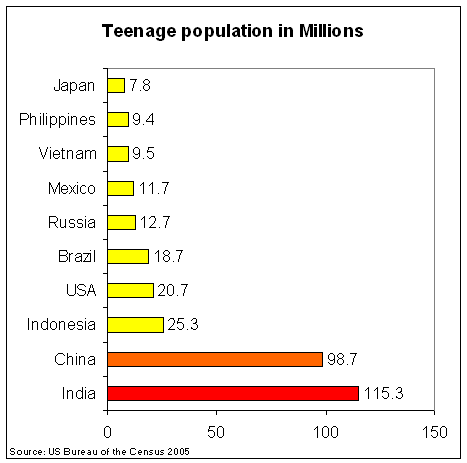
Everyone knows that India has a large population. This large population offers huge opportunities in different demographic segments. One of such attractive segment is the youth or teenage population.

India is home to the largest population of teenagers anywhere in the world. India has about 115.3 Million teenagers!! This number even surpasses the number of teenagers in the US, Canada, UK, France, Germany, Italy and Japan combined. (BTW, these are called as G7 countries and they account for more than 80% of the global wealth). This astounding number of teenagers in India poses an immense market potential for a whole lot of products: Fashion accessories, Fast foods, books, education, clothes, music, electronics. Sports, entertainment etc.

Few early investors are already reaping the benefits of this huge teenage population: Levi’s, LVMH, Adidas, Nike, MTV, Disney, McDonald's, Pizza Hut, Domino’s, Subway, Pepsi, Coca Cola to name a few. But the market is still wide open for others to enter and capitalize on the potential.

Market Potential

  • 74% of the urban teenagers have cell phones
  • 81% of the urban youth use computers
  • 89% watch television daily
  • 73% listen to radio
  • 91% watch movies regularly
With the Indian GDP growing at close to 9%, India is poised to become the third largest economy by 2012 (surpassing Japan), India offers an unparalleled business opportunity for all. A study conducted by Business Today estimated that Indian youth in cities alone spends Rs 190,000 crore a year - $42 billion dollars!

Indian youth are highly brand conscious and are willing a pay more for a reputed brand. Erich Stamminger President & CEO, Adidas Brand, Adidas has this to say about Indian youth: "Indian consumers are very rational in their purchase decisions. For them , the brand name is important. I think they will consider entering your store only because of the brand you are but they always need a rational argument about functionality and utility of a brand before making the final purchase decision."

Another display of youth power in India can be seen at Louis Vuitton - a wopping 18% of all LVMH sales in India comes from the teenage customers!

Closing Thoughts

Economy is always driven by the market demographics. The population in the US, Japan and Western Europe is aging rapidly. This implies that the business which sell to teenagers & youth cannot expect growth from these countries. Instead companies must concentrate on countries which have a large youth population - like India. Several American firms have realized this and are actively exploring the market entry options. So as Starbucks is poised to open its first outlet in India in 2007, will Dunkin Donuts, Cafe Nero, Costa Coffee sit idle and watch Starbucks capture Indian market?

Also See:

Why Invest in India - Power Generation
Why Invest in India: Innovation & Creativity
Knowledge Management - The blood & lifeline of any company
Creating a Culture for Innovation and Protecting Intellectual Property - Part 1
Creating a Culture for Innovation and Protecting Intellectual Property - Part 2
Protecting IP Assets of an Organization
Types of Intellectual Property
Business Creativity and Innovation
Indian Style of Innovation
Joint Ventures is a preferred way to Enter India
Emergence of Indian MNCs
Global Retail Giants are Eager to Enter India

Thursday, December 14, 2006

A Looming Threat for Global Retailers in India

By now most people who read my blog would be aware that Wal-Mart is finally entering India via a 50:50 Joint Venture with Bharti. Very shortly, TESCO will also be making another big splash on entering India with another tie-up. While this bodes good news to Indian economy and increases foreign investment in India, there is a looming threat to all the organized retailers: A severe talent shortage.

Talent Shortage in India

I had briefly mentioned about this talent shortage in my previous article. But the crisis is really BIG. Global giants really have a big problem on their hands - when it comes to rapid expansion in India.

This is a surprising challenge for Organized retailers - especially global retailers in India is shortage of talent. Yes, for all the population that exists in India and for all the shops, India has a serious shortage of experienced people resource for retailing. Number of people experienced in managing complex supply chain, people who have basic merchandising skills, people with store planning skills are very few. As a result, most of the existing retail stores have poorly organized merchandise, inadequate inventory, and excessive inventory - leading to lost sales and increased capital requirements. (see: Increasing Sales in a Retail Store - An Indian Context ) Global retail giants will have to spend substantial resources in terms of time & money to train local workforce and bring them on par with their global standards.

If finding store managers is a challenge, the bigger challenge is to find the adequate workforce for store clerks, cashiers, sweepers, helpers etc. The problem here is not that of availability - but that of availability of the right kind of people - and the cultural divide that exists between the potential employees and their employers.

To understand the talent crisis, take a look at the demand for workers. Currently the Indian retail sector - both organized and unorganized employees close to 40 million workers. Of which only 1.8 million workers are employed in the organized retail sector. Most of these workers are also shop owners - India has an estimated 30 million shops & kiosks. A vast majority of the people who are employed in the stores lack the skills to work in an organized retail sector.

Retailers Association of India estimates that an additional 2 million workers will be needed in next two years - this is to meet the requirements of the existing planned expansion in the retail sector. Hiring and training in such large numbers in such a short time will be a challenge for even the biggest retailers.

Hiring the Right Talent

Most people who work in retail shops are school dropouts from mainly rural background, they do not speak English nor do they understand the sophisticated IT systems. Added to this there is a social stigma for working at a shop. Indian society does not give respect for such professions.

All this implies that global retailers must develop a unique strategy to hire and train their shop floor staff. As a result most workers treat working at a retail outlet as a temporary job - till they find a better one in an "office". This implies that employee turnover will be very high - as much as 40% per year. At such rates of turnover, people management becomes a big challenge. Global retailers will have to develop unique organization development strategies, employee retaining strategies and also have a plan to improve the image of working in shop - i.e., remove the stigma of working in a shop.

Global giants will also face a challenge when it comes to recruiting the quality talent in India - as most of the shop floor workers are not well educated, they will not be aware of companies such as Wal-Mart or TESCO or Target. On the contrary - every villager in India has heard of Reliance, Tatas, and the likes. Thus the battle for hiring the right talent will be doubly difficult for global retailers.

Cultural Divide

MNC’s have the tendency to hire the best talent. In India they will do the same. So the companies will hire the top MBAs to manage their operations. But these people often tend to come from the upper castes and they have a social stigma when it comes to dealing with people from lower castes - the shop floor workers. This social barrier will cause a lot of operational problems. In addition, people in the corporate headquarters will have cultural barriers when it comes to dealing with their local managers in India. Thus this double cultural barriers can deliver a knockout blow to any global giant.

Global retailers will have to cast a wide net to get the right kind of talent. In urban areas, most of that talent will come from school dropouts and are slum dwellers. Making a good salesmen out of them will involve intensive training and above all extraordinary management skills. Retailers need to invest a lot in soft skills training, behavioral training, customer orientation, sales training, etc. And at the end of the day, these workers who live in slums or shanty houses without basic facilities - will have to dress up and come to work in sparkling air conditioned retail outlets.

Global retailers will have to expand beyond the metro cities - to tap into new markets and hire the right talent. Here in second tier cities and towns, English is not a primary language. It is always the local language of the state: Kannada, Tamil, Telgu, Marathi, Hindi, Gujarthi, Punjabi, and 20 other languages. Global retailers must build the capability to carry out operations in multiple languages, train its staff to speak in both local language, national language (hindi) and if required in English. Even though the shop floor employees need not know multiple languages, the store managers definitely need to know.

Closing Thoughts

Global retailers may be eyeing Indian markets eagerly and few are hustling for that elusive first mover advantage - but they face a huge challenge in India. Success in Indian retail segment will be a hard won battle - battle not against competition, but a battle against the business environment. This implies that success in India will depend on prudent leadership and their ability to overcome the cultural differences to create a talented workforce.

Also see:

Global Retail Giants are Eager to Enter India
Increasing Sales in a Retail Store - An Indian Context
Wal-Mart is in Trouble in UK too!
Trans-cultural Business Failure - Wal-Mart Exists Germany
Partnerships for Increasing Business Opportunities

Global Retail Giants are Eager to Enter India

Recently I went to a movie in Bangalore. It had been quite some time since I did that - for the fact that I was in London. In the last 6 months so many things have changed in Bangalore - that I was surprised by all the new development. Old buildings have been torn down and new one being built all the time. And these new buildings are housing new shops, offices - that I had seen in the US & UK. A walk in a shopping Mall in Bangalore reveled so many international retail stores - Marks & Spencer's, Swaroski, Lewi’s, Bose, Nike, Reebok, Sony, D’mas, etc. All these started operations in last 2-3 years. But the real surprise is the fact that 100’s of global retailers are eager to enter India.

According to AT Kerney’s report, India is the most favored destination for global retailers. AT Kerney’s Global Retail Development Index 2005 puts India at the top.

India Offers a Vast Opportunity

The sheer size of Indian retail segment - almost $1 trillion! - and growing at 15% is exciting enough for all global retailers. Wal-Mart recently entered into a JV with Bharti and will soon be setting shop in India. Other retailers waiting on the wings are: TESCO, Carrefour, IKEA, Target, VF brands, etc. The rush to enter India intensified in 2006, when government opened up Foreign Direct Investment in retail sector. Added to this is the fact that Indian consumers are under served by the existing retailers. A vast portion of Indian population lives in Villages or non-metro cities - which are poorly served. This implies that almost 70% of Indian consumers do not have access to quality retail markets - And that segment is worth more than $350 Billion.

Opportunity has Road Blocks too

However, foreign retailers are subject to host of regulations. For example, only single brand retailers can now own upto 51% of the equity - this forces them to enter into JV with a local partner(s). Large format discount retailers - like Wal-Mart, Sears, Target are still not allowed in India. Yet global retail giants are eagerly waiting. Wal-Mart had setup two offices in India - mainly to study the Indian market. TESCO has setup an office to source from India and to learn the local operations.

Another big problem in setting up operations in India is the availability of real estate space. Traditional Indian shops have been small ~ 1000 sq. feet. Many of the inner city buildings are old & depilated and is unfit for global retailers. This is forcing retailers to build in the outskirts of the city and hope that people come to them. Metro built huge stores at the edge of the city - these stores are in Cash-and-carry format catering to small shops. Setting up new super stores on outskirts of the city is not easy either. Tax laws in the country and social pressures have caused fragmentation of land holdings. So if one wants to buy a large plot of land, one has to negotiate with hundreds of land owners - which will take time and endless negotiations.

The next problem in setting up organized retail operations is that of supply chain logistics. India lacks a strong supply chain when compared to Europe or the USA. The existing supply chain has too many intermediaries: Typical supply chain looks like:- Manufacturer - National distributor - Regional distributor - Local wholesaler - Retailer - Consumer. This implies that global retail chains will have to build a supply chain network from scratch. Which might run foul with the existing supply chain operators. In addition to fragmented supply chain, the trucking and transportation system is antiquated. The concept of container trucks, automated warehousing are yet to take root in India. The result: Significant losses/damages during shipping.

A surprising challenge for Organized retailers - especially global retailers in India is shortage of talent. Yes, for all the population that exists in India and for all the shops, India has a serious shortage of experienced people resource for retailing. Number of people experienced in managing complex supply chain, people who have basic merchandising skills, people with store planning skills are very few. As a result, most of the existing retail stores have poorly organized merchandise, inadequate inventory, and excessive inventory - leading to lost sales and increased capital requirements. (see: Increasing Sales in a Retail Store - An Indian Context ) Global retail giants will have to spend substantial resources in terms of time & money to train local workforce and bring them on par with their global standards.

The Hidden Challenge

Lastly, there is a HUGE hidden challenge. The challenges mentioned above are just the tip of an iceberg. The biggest challenges are well hidden: and that is cultural differences, political challenges, policy regulations, and ethical standards.

Indian consumers are different. The cultural differences have to be accounted when designing the store, setting up the merchandising mix, servicing the customer in the store etc. These cultural factors come in several flavors depending on which part of India you are looking at. Writing about all the cultural factors that pose a challenge to global retailers is beyond the scope of this article. I will write about them in future. The cultural nuances of the Indian consumer is so complex that it cannot be documented in a blog - instead one needs to write a whole book on that topic.

Political challenges are something which the global retailers will have to deal with. India is a federal state. With a national government at the center and state governments ruling the states. This implies that there are multiple sets of political and governmental clearances are needed for retailers. Having a national license from New Delhi will not suffice. One also needs clearances from various state governments, city corporations, district administration etc. Negotiating this for a global retailer will prove to be a challenge. For example, POSCO - Korean steel manufacturer found out to their dismay - that having a Government clearance is not enough in India.

Another challenge for most retailers is that of ethics. Global companies tend to have a different ethical standards - which may be against giving bribes or supporting local political candidates etc. But adhering to these standards in India will surely cause lot of problems to their local operations. How companies go about resolving this problem is a serious question. Many companies therefore prefer to have a local partner who can take care of these issues - but this has some serious implications.

India is a socialistic democratic country with a strong labor union movement. Global retailers will have to deal with the concept of unions. US based companies such as Wal-Mart has a strict policy of no unions in their company. However that policy will be severely tested in India in the long run. Local unions will not impose themselves on the global retailers in the beginning - but over a period of time, unions tend to creep in. Even in ITES/BPO sector, unions are trying to muscle their way - but is being resisted by the government and investors.

Hidden Competition

On the first appearance, the fragmented Indian retail sector looks like it may not offer serious challenge to the global giants. But the truth is far from it. Indian retailers are a resilient lot and will offer intense competition - against which the global giants will find it tough. It will be more like an army of ants bringing down an elephant. To understand this consider the case of Metro - the German retail giant in India. Metro entered India in 2003 with a superstore format. Metro wanted to sell to other small shop owners/retailers on a cash-and-carry basis. Initially Metro was able to give a significant price discount when compared to other retailers - but soon that advantage disappeared. Local retailers are now able to beat Metro on price on most items.

Closing Thoughts

India offers the greatest opportunity for retail business - But it also offers the most complex challenge for them. Global retailers who have succeeded abroad in multiple countries will struggle in India. But the size of Indian opportunity is so much that global retailers will take their chances. Success in India will depend on the local partners, consultants and executive leadership.

Also See:

Trans-cultural Business Failure: Wal-Mart Exits Germany
Increasing Sales in a Retail Store - An Indian Context
Wal-Mart is in Trouble in UK too!
Partnerships for Increasing Business Opportunities

Tuesday, December 12, 2006

Joint Ventures is a preferred way to Enter India

India has emerged on the global business map and global giants are eager to enter India. In their rush to enter India, global companies are entering into a slew of joint ventures and strategic alliances. While some of these ventures are driven by government regulations, most are driven by their need to lower risks. In my previous article, I had mentioned that JV offers a lower risk option to enter newer markets for Indian companies venturing abroad. The same hold true for foreign firms entering Indian markets.

Notable JV of Recent Times

  • Tata Motors & Fiat: The JV will manufacture cars from Tata & Fiat stables. Tata Motors will also buy diesel engines for it cars from Fiat, while Fiat will distribute Tata cars in Europe.
  • Mahindra & Renault: This JV is the market entry strategy for Renault. The JV will manufacture Renault’s Logan cars in India. Renault will gain market knowledge - while Mahindra’s will learn how to make good cars, and leverage its dealership network to additional profits.
  • Tata-AIG: This JV was created to take advantage of the new government regulations on private insurance companies. Private insurance companies need foreign collaboration for technical know how. While the current regulations prevent foreign insurance companies setting up a green field venture in India. Similarly other JV in this field are: ICICI Lombard, ICICI Prudential, Bajaj- Allianze etc.
  • Bharthi-Walmart: JV was primarily created by Wal-Mart’s desire to enter India and the government regulations regarding large foreign retail firms operating in India. This 50:50 venture with Bharti will give Wal-Mart an entry into India ( a long awaited one at that)

Why form JV?

The main reasons for a JV has always been an entry strategy. JV provides a lower risk option of entering into a new country. For Fiat, Pepsi, Ford, Xerox, Suzuki, etc., the JV is an ideal way to enter Indian markets and establish itself as a leader ahead of other competition. The JV also provides an opportunity for both the partners to leverage their core strengths and increase the profits.

For example, Modi-Xerox venture gave Xerox an early lead in the photocopier market and help secure a strong brand recognition. For the Modi group, this turned out to be a very profitable venture. JV also provides a learning opportunity for both the partners. A smart partner will learn a lot about other partner’s capability. For example, Xerox learnt about distribution channels and copier usage model from the JV. TVS learnt a lot about making motorbikes from Suzuki.

Other reasons to form a JV in an Indian context are:

Technology: When partners have mutually rights over exclusive technology, then JV forms an option to exploit the opportunity by combining these technologies. Alternatively, when a partner has identified a profitable market opportunity - but does not have the necessary technology, then a JV is an option to go. However both parties need to have a good understanding to protect each others IP.

Lower Risk of Geographic Expansion: A JV with a local partner is an ideal way to minimize risks of cross-border expansions. For foreign firms a JV with a local partner lowers risks via: ability to hire the best talent, knowledge of local markets, connections with local government, pre-existing distribution networks etc.

Government Regulations: In most emerging markets government rules and regulations prevent foreign players from establishing a wholly owned subsidiaries. For example, Indian government laws prevent foreign retailers, insurance companies from entering India directly. The current regulations force these companies to form JV with local partners

Access to Capital: Often times companies in emerging economies lack capital to expand. A JV or an strategic investment will infuse capital to the local operations and make it more profitable. In an emerging economy - the local partner provides the distribution network, human capital and government links as its investment in the JV, while the foreign partner provides the capital and technology.

JV has a definite Life span

All JV’s have a definite life span. Oftentimes the end objectives and exit strategy will be negotiated during the formation of the JV itself. Despite the fact that everyone knows that a JV has a definite life span, most JV falls apart earlier than expected.

The main reason why a JV falls apart is changes in partner’s strategy. Often either one of the partner changes their strategy which makes this JV redundant. For example Ford-Mahindra JV. Ford wanted to expand the operations but Mahindra wanted to focus more on SUV segment and did not want to invest for the expansion. Thus forcing Ford to go alone.

Often times the conditions which made a JV necessary change - like government regulations, access to technology or capital or the partner has gained sufficient confidence to go alone: All this causes the JV to fall apart. For example TVS-Suzuki JV fell apart when TVs learnt how to design motorbikes on its own. TVS designed "Victor" on its own and it was a success. This gave TVS the confidence to go alone.

Another popular reason why a JV falls apart is when the JV is successful. The JV becomes a cash cow and both the parties now want greater control over it. This often results in a nasty fight for control - and in the process the JV falls apart. Alternatively, when a JV is not doing well, the partners start blaming each other and want to take over the control to prevent further deterioration.

Closing Thoughts

Joint Ventures are becoming a popular means to enter Indian markets for global giants. However, the risks of cross-border expansion are slightly lowered, but they still remain. To have a successful JV, both partners should have a good understanding of each other’s cultures, establish a good work collaboration and work towards a common objective. The risks of cultural integration still exist - often times management from both the sides often ignore the cultural integration issue assuming that they can take care of it - but cultural integration often falls between the cracks - and the JV ultimately fails.


Also See:

Successful Joint Ventures

Sunday, December 10, 2006

Emergence of Indian MNCs

Year 2006 will probably known as the year when Indian businesses & Indian businessmen emerged on the global map. India’s emergence in the global business arena has been driven mainly by acquisitions and mergers. In January 2006, Lakshmi Mittal CEO of Mittal Steel launched a hostile takeover bid for Arcelor - which was completed by July 2006. On similar lines, Tata Steel went abroad with acquisition of NatSteel in Singapore and Corus Steel in the UK.

Notable cross-border acquisitions

Some of the Notable cross-border acquisitions in the year 2006 are:


  1. Videocon Industries buying Daewoo Electronics - $731 Million
  2. Dr Reddy Labs acquires Betapharm Arzneimittel - $572 Million
  3. Ballarpur Industries buys Sabah Forest Industries - $261 Million
  4. Ranbaxy Labs acquisition of Terapia - $324 Million
  5. Suzlon Energy buys Hansen Transmission - $565 Million

In total, Indian firms spent $15.72 billion in 192 overseas acquisitions. While this number may not be significant when compared on a global scale, this number is significant in the global context. The real significance of this should be seen from the fact that next year this number could double or even triple, making India as Asia’s largest acquirer abroad.

India Plays with Global Expansion

Indian companies are using all the tricks of the trade to go global: Mergers & Acquisitions, Organic expansions, Green field investments, and Joint Ventures. The scale and the business share may not be significant today, but Indian businesses are slowly but surely establishing themselves abroad.


Tata Motor’s successful acquisition of Daewoo’s truck unit in 2002 in S. Korea has become a classic business case study. Tata acquired a loss making unit - and without any layoffs, turned the loss making unit around. This built enormous goodwill and reputation for Indian companies in S. Korea. This helped Videocon acquire Daewoo Electronics and is aiming to acquire LG-Philips LCD Co. In S. Korea. Success of one acquisition in a particular country/market has prompted other Indian companies to look for acquisition in the same country. Given this mentality, one should not be surprised if Indian companies make a major acquisitions in S. Korea in 2007.

Similarly, Tata’s successful acquisition of Tetly Tea in UK prompted several Indian companies to look for acquisitions in the UK and European markets. Tata-Corus deal (if it succeeds) will mark a new beginning for mega deals involving Indian companies.

Why opt for Acquisitions

Indian companies have long practiced conservative business practices, have maintained almost zero debt and are in very good financial health. This when coupled with access to significant pools of capital - either foreign debt or stock markets - creates an ideal situation for acquisition abroad. Another potent power which Indian companies can leverage is its vast pool of highly talented human resources. All this when combined together creates an ideal conditions for Indian companies to expand abroad.

The reasons for cross border acquisitions by Indian companies stems from their traditional thinking: Reduce risk and build global competencies. Cross-border acquisitions make natural sense for Indian firms. The five main reasons (pretty much in the same order) why Indian companies opt for acquisitions are:

  • The lure of access to global markets.
  • Leveraging the synergy with the existing businesses
  • Strengthening the acquired company - via better management
  • Reduce competitive threats and vulnerability to other global giants
  • Create a Global Company.

To understand, consider the example of Dr Reddy Labs acquisition of Betapharm Arzneimittel. This acquisition gives Reddy Labs access to German and high grown Central & Eastern European markets. Betapharm Arzneimittel’s business has a good synergy with Dr. Reddy’s existing business, and give the company a significant presence in Germany.

In 2006, the largest number of acquisitions were in the pharmaceuticals sector, followed by IT and manufacturing sector. Indian companies are buoyed by strong local demand, red hot stock market, strong management capability and a desire to move up the value chain. Indian managers have the vision to go global - this vision is further encouraged by brain gain, when experienced expiates are returning back to India and using their rich experience and capability to help local firms expand abroad.

Risks in Cross-Border Acquisitions

Cross-border acquisitions are always fraught with risks. Indian companies also have to face a lot of risks when compared to European, Japanese and American companies. The risk is greater for Indian companies - mainly because Indian firms lack experience in international acquisitions & mergers, coupled to it, Indian companies are not exposed to different cultures. The five biggest risks Indian companies face cross-border acquisitions are:

Risk of overpaying for the acquisition or Risk of over-leveraged acquisition
In a competitive bidding scenario, there is a high possibility of over bidding for the acquisition, and that may result in Indian firms over-leveraging for the foreign acquisition. This risk is particularly very high in a cyclical markets when the market is on the upswing.

For example, Tata Steel would be over paying for Corus Steel if Tata outbids CSN. CSN had bid 475 pence a share Vs Tata Steel’s original bid of 455 pence a share. Coupled to that Tata Steel’s acquisition strategy is driven by taking on large debt to pay for Corus acquisition - and things can get really nasty if there is downturn in the global steel industry.

Risk of downturn in the global market

Companies which deal in commodity products: steel, metals, chemicals, etc. face the risk of global downturn in markets. For example, Tata Chemicals acquired UK based Brunner Mond - this acquisition made Tata Chemicals the 3rd largest manufacturer of Soda Ash. If there is a downturn in this market, then Tata Chemicals will be in trouble. (Also see: China’s Globalization Plans off to a rocky start)

Cultural Integration Risks

Cross-Border acquisitions always carry the risk of cultural integration. Though this risk exists in all acquisitions, the risk is particularly greater in a cross-border, cross-cultural acquisitions. For example when Tata Motors was bidding for Daewoo truck division, The biggest challenge for Tata Motors was to convince the bankruptcy courts that Tata Motors are a serious about their bid and had a viable revival plan. Toughest challenge for Tatas was to integrate Korean workforce with the new Indian-Korean management. Similarly, when Indian companies acquired American firms in early 2000, there were cultural integration issues - where American employees were reluctant to work under the Indian management.

Government Regulations can affect Global Markets

Sectors like health care, Pharmaceuticals, and Energy are highly regulated by governments. Changes in government regulations can have severe impact on the profitability.

Political Instability in emerging MarketsRisks of political instability are very high in emerging markets. For example coup in Thailand, Fiji, instability in Nigeria, Central Africa, Zimbabwe etc. Can have adverse effect on profits. Many Indian companies are expanding in Africa, and Asian markets - which are susceptible to political risks.


Minimize risks with Partial Acquisitions

Since acquisitions carry a great risk - companies can try to take another route to avoid the risks of an outright acquisition - use partial acquisition. Partial acquisition is when a company acquires a substantial stake in another company - and with a right to buy the remainder as per a predetermined plan or without an option to buy the remainder.

Companies like to use this option of partial acquisitions so that they can learn the local operations from the partner - without exposing themselves to these operational risks. This is a preferred way to enter new market segments and new geographies - where the company has very little experience. For example, Tata Tea has acquired 30% stake in Energy Brands Inc., the maker of flavored tea drinks. Since Tata Tea does not have expertise in selling soft drinks - this will be an ideal way to venture into new areas. Similarly, ONGC has invested 15% in a Brazilian oil exploration venture.

Joint Ventures is also an attractive option

Ranbaxy completed five acquisitions in the year 2006. This is surely a mark of success and confidence, for Ranbaxy - this was just another year in their long march towards becoming a global pharma giant. Ranbaxy started venturing abroad via joint ventures. In 1977, Ranbaxy expanded into Nigeria via a joint venture. Today Ranbaxy has several JV all across the world.
Joint ventures offers a low risk option for going abroad. Often times, a joint venture is used as an entry vehicle into foreign markets. Aditya Birla group used joint venture as a preferred means to enter into Thailand, Egypt, China, Canada, and Indonesia.

Another company which used JV to successfully expand abroad is Essel Propack. Essel Propack is the world’s largest manufacturer of lamitubes - used to package toothpaste, gels, and creams. Essel operates in 14 countries and has 24 manufacturing facilities. Many of these outposts were created via JV, acquisitions and green field ventures. Essel’s march into the global scene has been partially driven by the fact that its main product - "empty tubes" are not cheap to transport, thus forcing the company to setup manufacturing facilities close to its customer locations. Essel has a global vision and an advantage of lowest cost operations. This helped Essel acquire Propack - which propelled Essel to the top.

Main reasons to opt for Joint Ventures: Lower risk Option
Joint Venture with the local partner will lower the risk as the local partner knows the local market, the local partner has greater capability to attract talent, has the necessary contacts/links with the local government, and provides an entry into new markets.

Unfortunately, JV also has the highest failure rates - if the venture becomes successful, one partner will try to muscle out the other, or if the venture fails, the partner tries to blame the other. Having a well defined exit strategy is vital to prevent a painful breakups.

Green field Ventures

Establishing green field ventures is a core competence for several Indian companies. Tata group for example has setup several green field operations in South Africa, Kenya, Nigeria, Sri Lanka, Vietnam, etc. Mahindra & Mahindra has setup new operations in China to make tractors.

Indian companies have been very prudent when expanding into newer territories. Indian management lays a great emphasis on integrating the overseas operations first. Only when the management gets a feeling of comfort that the overseas operations is fully integrated, Indian managers will look for further acquisitions.

A classic example of this prudent expansion is Asian Paints - 2nd largest manufacturer of decorative paints. Asian paints started global expansion in 1999. Initially this was done via small acquisitions in Egypt, Sri Lanka etc. This was followed by well managed integration and then a green field expansion. By 2003, the company had enough expertise and experience to play a bigger role in acquisitions - it acquired Berger International. This acquisition gave Asian paints a global reach to market its products over 70 countries.

According to Ashwin Dani, MD of Asian Paints: "We have rolled out a mega operational efficiency initiative which focus on productivity, safety, environment, reducing losses, planning & Control systems. So the message is clear - you should constantly adding value to your acquired operations"

Closing Thoughts

These risks have not decreased Indian companies appetite for acquisitions. Understanding these risks have prompted Indian companies to approach cautiously towards acquisitions - starting with small, less than $30 Million, all cash acquisitions in late 1990’s - Indian companies have progressed steadily to multi-billion dollar acquisitions. Several Indian business houses have built a dedicated capability for acquisitions: Tatas, Ranbaxy Laboratories, Dr. Reddy Labs, Wipro, Ruias, Videocon, Kalyani etc. Past successful acquisitions have also added to the confidence levels of Indian firms.

While Indian firms are expanding abroad - more global giants are entering India. Global Retail giants, Banks, Insurance companies, manufacturing firms - cars, tyres, consumer goods, heavy engineering, chemicals etc. - all are eager to enter India. Some are forced to enter into joint ventures with Indian companies due to legal legislation while others are pondering on how to enter Indian markets.

International business fraternity has finally recognized that Indian firms are credit worthy and has the expertise to successfully manage global assets. This confidence can be seen how willing the banks are willing to help Tata Steel to acquire Corus.

Indian companies have just started venturing abroad. In the next decade, lot of Indian multinationals will be listed in the Fortune-500 list of companies. As a vanguard of things to come, Infosys is now listed in NASDAQ-100 index - the first Indian company to achieve this fame.

Also See:


  1. Cultural Assessment - Prerequisite for successful Mergers
  2. Challenges of Working Across Cultures
  3. China’s Globalization Plans off to a rocky start
  4. Build a Multilingual Web Site to cater to your Global Customers
  5. Why Build a Global Website
  6. Improved Cross-cultural Communication Increases Productivity
  7. Managing Global Careers - Dealing with Culture Shock
  8. Keep Overseas Staff Focused on the Right Goals
  9. Trans-cultural Business Failure: Wal-Mart Exits Germany
  10. Making Multicultural Virtual Teams Work
  11. Virtual Scale - Alliances for Leverage