Friday, March 03, 2006

People Capability Maturity Model and Organizational Capability

I work at knowledge based services firm – which involves product design, manufacturing & logistic services. Our core competitive advantage is derived from the talent of the employees who deliver these services. So this article is all about managing and developing employee talent.

In a knowledge based service industry such as consulting, design services etc., employee talent is the key for success of a firm. When the performance of the organization depends on the talent of its employees, top management will have to look at ways to improve the skills of its employees.

Carnegie Mellon University’s Software Engineering Institute developed a framework to improve the capability of employees – called as People Capability Maturity Model (PCMM). PCMM helps organizations develop the skills of their employees in a phased manner. It also helps address critical people issues based on current best practices in HRM, knowledge management and organizational development. PCMM provides a guideline for developing and managing their workforce.

In my organization’s context, employee skills is the key for successful business performance and with the threat of losing key talent (to competitive firms), HR strategies has to focus on the latent and apparent needs and aspirations of employees. The challenge for the management is to align employee development program with that of the organizational goals.

PCMM levels

Carnegie Mellon University ahs defined five distinct levels under which any organization can be classified based on their employee development plans. The People CMM consists of five maturity levels that establish successive foundations for continuously improving individual competencies, developing effective teams, motivating improved performance, and shaping the workforce the organization needs to accomplish its future business plans. Each maturity level is a well-defined evolutionary plateau that institutionalizes new capabilities for developing the organization's talent pool. By following the maturity framework, an organization can avoid introducing workforce practices that its employees and managers are unprepared to implement effectively. These levels are:

  • Level-1: Initial level.
    Organization has only the staffing functions.

  • Level-2: Managed Level.
    Here the organization has mapped out a well defined compensation plan, has performance management policies, has developed work communication & coordination structure and has a training & development plan for employees.
  • Level-3: Defined Level. Here the organization has developed a competency based HR practices, career development plan for employees, Workgroup planning and workforce development based on competency analysis.
  • Level-4: Predictable Level.
    The organization has now developed a mentoring program, empowered workgroups, quantitative performance management is practiced, and Employee competency is treated as a key asset.
  • Level-5: Continuous improvement.
    The organization continuously improves its capabilities, encourages workforce innovation and organization’s performance is aligned with the market needs.

In depth explanation of each of these PCMM levels is beyond the scope of this article as it digresses from the intent of this article.

PCMM: New paradigm in HR

Till recently, there was no global standard against which an organization could benchmark it’s HR processes. Hence, there was no way in which an organization could comprehensively measure its HR policies and align employee development with the business process. The People Capability Maturity Model (People CMM) is a tool that helps an organization to successfully address the critical HR issues in their organization and align the employee needs with that of the customer’s or market needs.

The PCMM’s primary objective is to improve the capability of the talent pool. Talent pool capability can be defined as the level of knowledge, skills, and process abilities available for performing an organization's business activities. Talent pool capability indicates few parameters of the organization:

  1. Readiness for performing its critical business activities.
  2. Likely results from performing these business activities.
  3. Potential for benefiting from investments in process improvement or advance technology.

Hence, the People CMM framework is one which attempts to build strong linkages of people processes with business results. PCMM enables firms to develop a mature policies and practices for continuously elevating talent pool capability. i.e., have a well defined training & mentoring plan. This is a significant shift from the ad hoc and inconsistent mode improving people capability.

The philosophy implicit in the People CMM can be summarized in 10 principles.

  1. In mature organizations, talent pool capability is directly related to business performance.
  2. Talent pool capability is a competitive issue and a source of strategic advantage.
  3. Talent capability must be defined in relation to the organization's strategic business objectives.
  4. Knowledge-intense work shifts the focus from job elements to people competencies.
  5. Capability can be measure and improved at multiple levels, including individuals, workgroups, people competencies, and the organization.
  6. Organizations should invest in improving the capability of those people competencies that are critical to its core competency as a business.
  7. Operational management is responsible for the capability of the talent pool.
  8. The improvement of talent pool capability can be pursued as a process composed from proven practices and procedures.
  9. The organisation is responsible for providing competency and career improvement opportunities, while individuals are responsible for taking advantage of them.
  10. Since technologies and organizational forms evolve rapidly, organisation must continually evolve their people practices and develop new people competencies.

PCMM is an evolutionary framework. It guides the organization in selecting high-priority improvement actions based on the current maturity level of their people practices. Benefit of PCMM is in narrowing the scope of improvement activities to those vital few practices that provide the next foundational layer for developing an organization’s talent pool. By concentrating on a focused set of practices and working aggressively to implement them, organizations can steadily improve their talent pool and make lasting gains in their performance and competitiveness.

Talent management in turbulent times can be done effectively by using the PCMM framework, which helps organizations to manage their talent, in line with their business requirements and revolving around competencies. This results in more motivated employees who work to delight the firm’s customers, thus giving the organization a strong competitive edge.

New strategy

A new comprehensive HR strategy should be customer oriented and revolves around developing employee competencies required to meet the new challenges. This requires a shift from the traditional HR strategies which were centered on meeting organizational goals – and were extremely inward looking. Organization is this global economy will have to use HR strategies as core competitive strategies. For example, IT services firms from India – such as Infosys, Wipro, TCS and others tout their CMM & PCMM level-5 certification as competitive advantage over other IT firms. Wipro was the first firm in the world to get the PCMM level-5 certification – and has used it in their marketing campaigns.

As the market conditions change and become global, various HR programs and initiatives must become customer centric. For example, if training on customer needs analysis is given to front end engineers, they will impact the customer directly by understanding their needs well, and deliver much more accurately - hence this would be a primary impact on the firm’s performance.

Let me give you another example. If the organization defines career path for its employees and develops career development plan which takes customer needs into account, employees can then measure and build their career based on the value they (employees) are delivering to the customer. And when employees are able to chart out their career paths within the organization, there will be lesser propensity to leave the organization and lower attrition means lesser project delays for the customer.

Closing Thoughts

Developing a HR strategy based on customer needs will redefine the role of HR to be more objective and have a greater impact on the organizational performance. This is a major paradigm shift for the HR. Human behavior is very subjective and hence HR department has been very subjective in the past.

People Capability Maturity Model transforms HR department to be objective and enables the organization to compete effectively through it's empoyee capabilities.

Thursday, March 02, 2006

Marketing & Sales Funnel


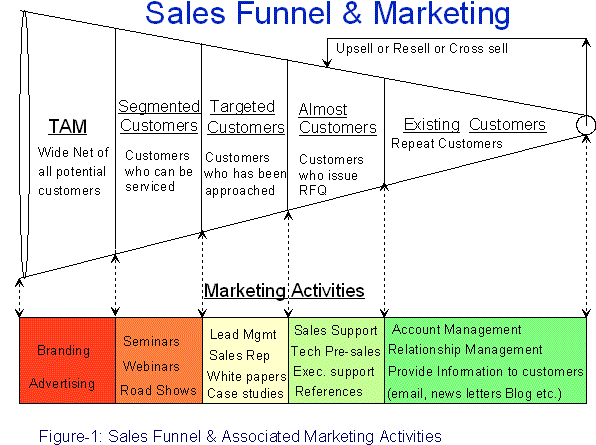
The sales funnel is a popular tool to graphically depict the sales process and the timeline for a future sale. Sales funnel is universally used in B2B sales - where sales cycles are long (typically several months) and closure of the sale takes some level of executive relationships or executive level selling. Role of marketing in a B2B sales can also be linked to sales funnel. In this article, I will write how various marketing functions are associated with the sales funnel.

A typical sales funnel is depicted in figure-1. As the name implies, there is a large list of potential customers in the beginning of the sales process - and as the process continues, the number of potential customers decrease. At the end of the sales process i.e., closed deal - a few become actual customers.

Marketing functions in a sales intensive company must therefore be aligned with the sales funnel. The underlying theme of most successful marketing operations is about segmentation, focus and targeting. In most firms there will be more opportunity than what the company can successfully pursue. This makes in imperative for the marketing department to create a strategy or define the rules which will initiate a winnowing process - i.e., narrow down the list of prospective customers which the firm can successfully pursue and close.

One model of the marketing activities in the B2B world starts with branding, and then builds awareness and interest, targeted prospecting, lead management, sales funnel support and, finally, customer life cycle marketing i.e., repeat sales.


Branding

The top level of the marketing function is focused on branding and the building of awareness and favorable associations. Having written several articles on branding, I won't say much in this article. It is sufficient to say that brand is a promise you make to the customer - once the customer experiences the product/service and feels that the product/service has lived upto the promise made by the brand, a brand value is created. In short, "walking the talk" in terms of your brand promise is essential to retain the customer.

The branding stage could be defined as the art and science of creating an association or nexus in the mind of a potential buyer, highlighting your offer and/or company and a desired characteristic such as quality, dependability, good value, etc. Activities in this stage may include general advertising through traditional media - mass media(trade magazines, journals, newspapers, TV, WEB etc.,) publicity and buzz campaigns, etc. and seminars for large segments for key decision makers (such as CIO, VP of sales, and so on).

The main message here is that you need a lot of impressions to create an imprint on the market's psychic awareness as well as to begin to fill the sales funnel. Depending on how fragmented and competitive the market is, you may only get 1-5% in terms of qualified leads out of such activities.

Building brand equity, however, takes time; the results may not manifest themselves for months or years. Many companies in the B2B space usually don't notice the adverse impacts of less marketing until 6-9 months after the initial budget cuts, when it's often too late to fully recover.

Targeted Prospecting

This funnel stage is where you've winnowed down the focus to your target markets and accounts. It is a process of identifying, analyzing and educating the key decision makers in the targeted markets/accounts.

It's surprising how often salespeople pursue opportunities outside their chosen targets (and sales managers let them), and win few of them. Brand-building and awareness campaigns at the top of the funnel will help the prospect education process in this stage. As Harry Beckwith writes in What Clients Love, "Advertising warms every marketing and sales effort that follows it."

Activities in this stage may include targeted seminars(or Webinars), account management, mapping any un-penetrated opportunity and specific vertical campaigns. The main focus here is to allocate resources to the specific targets where your company can add value, offer up a solution and can extract a profit.

Lead Management

A lead is generally defined as someone who shows an interest, through various means, in a company's offerings, although it's often defined differently depending on the organization. The key is to have a fairly granular definition that everyone agrees with. A lead could be generated from seminars, advertising, account mapping or Web sites, among other myriad marketing or sales vehicles.

Generating, vetting and distributing leads involves numerous processes and coordination efforts. Various studies show that most leads, especially in the B2B space, are not followed up on by salespeople or fully audited by management.

In general, if weak or unqualified leads are continually distributed to the sales organization, salespeople are less likely to give them much attention going forward. For example, in a 2003 META Group report titled "Lead Management: The Hinge Between Marketing and Sales," the authors write that "many Global 3000 organizations report that 70 to 90-plus percent of marketing-generated leads are not acted on, because sales finds them unqualified (an often-provided excuse for not making sales projections)."

If it's worth the effort to try to generate leads, it's worth the time to follow up in a timely manner. Also, if you don't track the lead source, it's next to impossible to determine what's working. Marketing ROI is often dependent on the value created from lead management activities. It is in this stage sales reps can add great value by following up on the existing leads - thus freeing up the company resources for other activities.

In terms of lead metrics, for example, cost per lead is meaningless if most of the leads are unworthy of pursuit and never end up as closed deals (the quantity vs. quality problem). Cost per opportunity or closed deal may be a better measure. Also, it's important to differentiate the leads that need to be nurtured and developed from those that should be acted upon immediately. (You could develop a lead funnel to differentiate the stages that a typical lead passes through.)

Marketing activities in this stage may include white papers, various events, newsletters and creating customer touch point opportunities. The idea is to generate and qualify interest and to separate those who are intellectually curious from those who are economically serious, which should be further vetted by the sales force.

Sales Funnel Support

Accelerating, expanding and winning deals in the sales funnel is the essence of good sales execution. At this stage, the sales funnel has been winnowed down to the opportunity level. The customer has issues an RFQ or an LOI indicating an indication to buy. Main function of marketing in this stage is to help sales to deliver the right message, to the right people, at the right time in the sales process is the essence of customer message management and providing good opportunity support. As Hartman and Staudt aptly state, "if you want qualified leads—people that can progress from being prospects to becoming customers and on to advocates—take the time to fine-tune your data and make sure that your messaging is personal and relevant."

Marketing can ensure that all sales collateral and messaging is built on the premise of aligning the company's solutions with customer problems, and crafting and proving the value story in a way that is targeted, germane and believable.

Marketing activities in this stage may include executive sponsor support (e.g., inserting and extracting an executive sponsor at the right time in the process), reference calls, collateral and conversation support and message management.

Customer Life cycle Marketing

Once you've acquired a customer, it makes sense to ensure that the customer remains loyal by consistently listening for changing lifecycle needs and value drivers. Banking is one industry that is quite attuned to the lifecycle of its customers (consumer and commercial)—from opening a first checking (or business) account, to obtaining a mortgage (or business loan), to funding one's retirement (or selling a business).

We know that numerous studies have shown that it's generally easier to sell more to a satisfied (even better—delighted) customer than a dissatisfied one, as well as to get solid referrals and leads.

A closed-loop marketing funnel should help to feed itself as satisfied customers tell their friends and colleagues, and help to corroborate your brand promise. (Recent empirical research has demonstrated a powerful customer loyalty barometer—the net positive response to the following question: "Would you recommend this product [offering] to a friend or colleague?")
Activities in this stage may include the development of customer groups (blogs, user groups, online communities, etc.), external account reviews, value reviews and performance reviews. The key tasks in this stage are for you to get credit for the value that you've delivered and for you to anticipate shifting customer needs.

Closing Thoughts

The sales funnel is an effective tool to manage and execute a complex sales process. The sales process can be made more effective and successful by aligning marketing activities with the sales process - branding, advertising, targeted seminars, whitepapers, technical pre-sales, account management, closing deals and looking for ways to add incremental value to existing customers.

Like most framework tools, sales funnel can enable you to identify, isolate and improve marketing black holes and/or upstream dependencies.

In my experience, educating customers is more difficult if they have no awareness of the offering category and your company's place in it. Qualifying opportunities often takes longer if you have not refined your targeting. In other words, the marketing functions has to be aligned with sales funnel and this will make the sales process smoother & more importantly - efficient.

Finally, understanding the flow, the hand-offs and the overlap between the marketing and sales funnels would go a long way toward improving integration between the respective functions as well as to better pinpoint accountabilities and lessen finger-pointing. In many competitive selling environments, where exploitable differentiation is paramount, marketing and sales alignment is the Holy Grail for effective selling.

Thursday, February 23, 2006

Sales - Knowledge is strength

In my previous blog on sales (Sales - Its all about money), I had written about the importance of money in securing a sale. In a B2B environment, customer will buy from you only if there is a financial benefit for his/her firm. Customer will buy only if:
  1. Your Product/Service reduces customer’s expenses without lowering performance/quality
  2. Your product/Service enables the customer to maximize his profits or ROI
  3. Your product/service reduces the business risks

The salesman goal is convince the customer the financial benefits of buying his product. To convince the customer, salesman must therefore know the financial details of the customer’s current alternative to the product/service the salesman is selling. This knowledge is of vital importance to a salesman to close the deal.

Knowledge about the customer

Getting to know the financial information about the customer is quite a task. Salesmen will have to spend considerable amount of time & energy to know about the customer.

However getting financial information about the customer is relatively easy. If the customer is a public company, then their financial information is freely available at www.sec.gov or at similar organizations (SEBI in India) in form of annual reports (SEC 10K), quarterly reports (SEC 10Q) and other financial updates (SEC 8K).

Sarbanes Oxley Act (SOX for short) has been a boon to all salesmen who are seeking financial information about their customers. SOX mandates that all the financial information disclosed to public through SEC 10K/10Q/8K must be accurate.

However, reading these reports and making sense out of these reports is a different matter. To understand the financial information in these reports one needs to have some financial accounting knowledge. It may be useful to enroll in an evening MBA class or atleast attend a few accounting classes to learn how to extract valuable information from the SEC reports.

If you have a non-US, public company as your customer, then it may be a good idea to hire a consultant or use your company’s accounts department resources to interpret the financial data of your customer. Please note that the accounting standards and practices vary across countries. Non-US firms report their financial data in a different format than the US firms. So it takes an expert in International Accounting to interpert International financial accounting information. Alternatively, subscribe to some stock analysis reports from investment bankers.

Every salesman will have a few privately held companies as customers. Getting financial information about private companies is difficult as these private firms are not mandated by law to publicly disclose their financial information. However, a few privately held companies do offer their financial data to public - either through their web sites or through market analysts. Another good way to get information about privately held firms is to through paid database services such as www.hoovers.com or www.lexus-nexus.com . In general, it is difficult to get quality information about a privately held companies.

The best way to get information about privately held companies is to ask:

  1. Their customers - i.e., customers of your privately held customer
  2. Their suppliers
  3. Employees/sales reps/salesmen of your customer firm

Information coming from such sources (customer’s customer/supplier/sales reps/employees etc.) must be treated cautiously - and must never be taken as a final word till it can be corroborated through a second source.

Invest time to get knowledge

Most successful salesmen will tell that they spend considerable amount of time learning about their customer. I have setup my financial news web site to grab any news about the companies whose stocks I like to invest in. Similarly, a salesman can setup his/her investment news web site (my.yahoo.com or www.etrade.com etc.) to collect any news or financial information about his existing/potential customer firms.

I also subscribe to newsletters from customer’s web site, investment broker firms etc. I also subscribe to online database providers such as www.hoovers.com & www.lexus-nexus.com to get information about privately held firms.

Knowledge is strength

Imagine that you as a salesman are in a meeting with COO of your customer - and you are doing all the talking. What is that the customer is most wanting to listen? - About themselves!! Its a well known fact that everybody likes to hear about themselves. So when you as a salesman have done your research and have gathered all that knowledge about your customer - I bet that you can have a long interesting ( to the customer ) conversation.

Having the knowledge about the customer’s financial, you can create custom offerings to help your customer and close the deal. The key advantage of having the knowledge about the customer - is that you can now customize the offering or atleast the payment terms or price that will best match the customer’s needs.

In short, the key point I am trying to communicate here is "Knowledge about the customer helps you close the deal"

Tuesday, February 21, 2006

Hosting successful Seminars

Today seminars - especially Technical seminars have become a common place. This month in Bangalore alone there are about 14+ seminars on various topics being held on diverse topics which range from CRM to EAI to lead free packaging to market research. These seminars are aimed at engineers - and is used to dissimate information of a particular product/service. Most engineers like these seminars - and marketers love conducting such seminars.

Seminars & its web variant Webinar are becoming a vital tool in the marketing mix. High tech products can be more easily promoted by seminars. But hosting successful seminars is not easy. Marketing manager has to overcome several challenges in order to host a successful seminar.
First step is to know the target audience, understand the needs and anxiety of your audience. This step involves choosing a right topic which is of interest. Most often, the right audience will be the employees, managers & executives of your customer firms, vendors and partners. Choosing a topic will help identify the target audience.

The next step is to figure out how to make them (audience) attend the seminar. This involves answering various questions such as: When to hold the seminar, Where to hold it? Who will be the lead speaker? How to promote the event? Etc.

It is the marketing manager’s job to work out the answers to the above questions. It needs lots of thought, planning and teamwork to host a successful seminar.

Content is king

No one wants to attend a seminar that sounds like a commercial advertisement. So pick a subject that really speaks to the audience you want to reach. The seminar should be educational and answers a problem faced by your audience.

Content of seminar is vital for its success. Content of the seminar should be boldly published to grab the attention of the potential audience and should promise useful information and a learning experience. Your target audience will ask themselves "What’s in it for me?" - and if the topic of the seminar is something of their interest, they will come.

A big name for keynote speaker helps

Who will be the main presenter? Choose a recognized expert, an author, a person who has succeeded in solving the problem presented—the more respected and known, the better your attendance. Selecting someone outside of your organization lends credibility to the value of the event.

For example, getting Dr. Philip Kotler to be the keynote speaker for a marketing seminar will ensure a huge audience. In such seminars others will also be presenting - others, including you or your associates, can also participate.

Big-name presenters may be easier to get than you think. Of course, you can pay them, if that’s in your budget. Once they learn about the planned promotion of the event, the amount of publicity they’ll get, and the exposure to an audience they want to reach, they may reduce their fee or do it for free. An offer to share the leads might be all it takes. The seminar gives them a platform, access to an audience, a chance to be the expert and gain more recognition for themselves or their company.

But a big-name presenter is not essential. Putting all your eggs in one basket may build a bigger audience for that one seminar, but a series of content-focused events pull more and better qualified leads in the long run. Multiple events offer prospects more convenient options of dates and times.

Timing is everything

You might have the greatest seminar ever, but if you have it on the wrong date, weekday or time of day, your target audience will be doing other things. Think about your prospects and check the calendar.

Eliminate holidays and the days before and after them. Forget about Mondays and Fridays. Mondays are too busy, and Fridays are for last-minute projects or early-departure days. Are there any trade shows that may conflict? How about end-of-the-month quotas?

Consider the time value of your expected audience. Since most attendees will participate if the seminar is before lunch (or if includes lunch). Seminars in the evening times must be avoided.

Most of your target audience may be heldup at work to attend the seminar. But having the seminar in the morning will be welcome as that will be the first activity for the day. From experience, I know that most prospects like to attend during lunchtime. (A free lunch has its own attraction)

Time to Promote

Once you pick a date and time, you need to decide on when to begin promoting the event and accept registrations. It has been found that Thirty days is the optimum time frame. Any amount longer, and the prospect may forget or lose interest. Less than 30 days doesn’t give you enough time to promote for maximum attendance. Also, it’s easier for your prospects to plan to attend something a month away than it is to plan for next week.

Realize that if you are planning only one seminar, some of your hoped-for audience won’t be able to make that day or time. A series of seminars is better, or a choice of two dates for the same topic would help solve that problem.

Trying to hit a home run with just one big event on one day is not the best strategy. Some valuable prospects may be vacationing, traveling or ill that day. So give them a choice of days or a series.

Proven Strategies to ensure a successful seminar

By practice, people have found a few proven strategies to make seminars successful. They are:
  • Leverage existing relationships. Take a good look at your trade groups, associations that pertain to the topic, your partners and your vendors. How can they help? Perhaps they may cosponsor the event. Can they publicize it in their newsletters, emails and website. Place a registration link on their Web site. Ask them to participate in some way.

  • Use your customer base. Unless you’re a one-product or one-service provider, your existing customers should be contacted often. They already know the value of your company and are very likely to attend the seminar. However, all too often, they may not know about your new offerings. They are your best prospects.


    New, qualified prospects are the lifeblood of any company. The goal of the seminar is to identify and deliver them. It’s easier for new prospects to respond to an informative seminar, because their worry about the sales pitch is lessened.

  • Merge promotion of seminar into your normal marketing program. That is the most economical method, because there is little or no additional cost. All your advertising—search engine ads, newsletters, email, banner ads, your own Web site, even print and broadcast—is ideal for mentioning the seminar and giving the link to register. It’s also a response-builder.


    If you exhibit at a tradeshow, have fact sheets and registration materials on display and urge staff to meet, greet and mention the helpful free seminar. Talking about the seminar may quickly lead into serious discussions of products and services on the spot.

  • Special campaigns get attention. In addition to merging the seminar promotion into your normal marketing, test some solo offers. These should feature the content, the value of attending and the convenience, and they should provide an easy way to respond. As you discover the value and results of seminars, you’ll budget more for special campaigns.

  • Involve your sales force and in-house staff. Invitation calls by your sales force to customers and current prospects are a wonderful way to get registrations and warm up prospects. A personal invitation is usually appreciated and remembered. It’s an easy call to make and take, and may lead to some business right on the phone.


    In-house staff can also help in the promotion. Be sure they are fully aware of the seminar. Provide them a script for discussing it with every customer and prospect they help.

Keep it simple, but get what you need

A quick and easy registration process helps maximize attendance. You don’t want to lose a good prospect by making registration too cumbersome or lengthy. Your goal is to get complete contact information, reinforce the value of attending, find out the source of the lead and get some qualifying information. All promotions should have the same registration page link so that you work with only one database.

Don’t lose two out of three

Our experience has shown that unless you send reminders after the registration, 67% of registrants won’t show up for the event. What a waste!

To prevent this loss, send an immediate "thank you for registering" email with a request to mark their calendar. Follow this up with another email reminder about 10 days before the seminar, a phone call reminder the day before the seminar will warm up your audience.

Maximize attendance after the Seminar?

Even with all the reminders, some registrants won’t attend—an unscheduled meeting, an illness, the press of business that day… things happen. You don’t want to lose these prospects, because they have already expressed a level of interest.

Record the seminar as a video file and put it on your Web site. Send non-attendees a "sorry you couldn’t attend" email with a link to the file on your Web site. Preparing the file costs around $500, but this gives you a permanent Webinar that’s on your Web site for other prospects to view.

If you choose not to archive the event, at least send non-attendees another email (or call) with dates and times of repeat seminars.

Are they hot, or warm?

Right at the end of the event ask the attendees to complete a quick, on-the-spot survey. Seminars are meant to be interactive. Use this opportunity to get immediate feedback and more qualifying information.

About 75% of attendees usually fill out the survey. They ask other questions, provide input that improves future events and, most important, give you insights about their level of interest, needs and time frame. Plan your survey carefully.

Follow up quickly

After the event, send each attendee a "thanks for attending" email. Send a survey to those who didn’t complete one earlier.

Now that you have hit the jackpot with all of these qualified leads - some warm, some hot, some as connections for the future - implement your sales plan. Get the information to your sales force and monitor progress and results. With a carefully planned event, you are sure to win new business.

Sales - Its all about Money

Till date I have written only about marketing in this blog. It does not mean that I don’t know about sales. Nor does that imply that sales is not important. Being in marketing, I have a lot to say about sales - especially about B2B sales. So this blog is the first in the series on sales.

Anyone who has sold any thing in their life will know that the final sale depends on the selling price. Also one notices that there are different factors that can influence the selling price (in either direction). But in the end - it boils down to one thing - Money!!

A sale is completed only when goods or services is exchanged for some money. ( I am talking about capitalist economy here - and not referring to barter). This understanding often creates an impression that sales is all about deciding on the final selling price - and hence all the hard bargaining is concentrated on the price. While this is true, it does not depict the full picture. In reality, a sale happens only when both the parties agree on the final price, payment terms and a contract is drawn that binds both the parties into doing an exchange.

It is all about Money

Money is the lifeline of any business and in all businesses it is the sale which brings in the money i.e., the income for any firm is derived from sales alone. (either sale of products or services or ideas. Even royalty income is based on sales)

Sales department is therefore solely responsible for bringing in the money (or bringing home the beacon). The rest of the organization is there to help sales or manage the money. Here again, I must say that bringing in the money is not a challenge for sales. The real challenge is bringing in more money in exchange for a product or service which costs lesser to produce internally i.e., the selling price must be greater than the cost of producing the goods or services - And this is a HUGE challenge.

The performance of the firm is measured in terms of Money. Investors use the terms Return on Equity, Return on Assets, Earnings per Share, gross margin, top line growth, Return on Investments etc.., to measure the performance of the firm. Note that all these parameters are based on money (coming in & going out). Sales is therefore playing a vital role in the success of an organization.

A good salesman understands that a firm must sell its products or services at a profit. Let me tell you a street smart business statement from my Gujrathi friend: "No Profit - No sale". He was very clear that he will not sell if there is no profit in that deal - And this is a fundamental truth of business. There are occasions when firms sell at a loss - this is done for various reasons: getting a strategic customer or gaining market share etc.. But this in pure business definition selling at a loss is not a sale - and must be rightfully called as "buying the customer".

Basic idea of sales

The basic idea is that all sales must be profitable. The final selling price must be above the reserve price - selling below the reserve price will incur a loss. Knowing the reserve price is very important for every sales person because that is the BATNA-Best Alternative To Negotiated Agreement. ( I will write more about BATNA later in this blog.)

Another important thing every sales person should know is what are the financial objectives of the buyer. In a B2B sale, all purchases can be classified into 2 categories:

  1. Necessary expenses - such as payroll, insurance, rents etc.
  2. Investment related expenses - such as capital equipment, raw materials etc.

And the customer will buy only if:

  1. Your Product/Service reduces customer’s expenses without lowering performance/quality
  2. Your product/Service enables the customer to maximize his profits or ROI
  3. Your product/service reduces the business risks

Therefore to make a sale, a salesman should be able to relate his product/service offering to the customer’s bottom line and convince the customer about the benefits. In other words, a salesman should be able to talk about the impact in $$ terms - i.e., "Its all about Money"

Closing Thoughts

Business to business sales is a very complex process. Money definetly plays a major role - but there is lot more to closing a deal than moeny alone. I will be writing more about sales in the future blogs.